
The PCC Streetcar's second return to San Diego
After two years, an icon of American railroading triumphantly returns to the Silver Line.
 12.02.25
 Samuel Sharp, Platform & Journal Lead
A young girl and her mother go sightseeing in downtown San Diego. It’s the early 1900s, the streetcar era is in full swing, and San Diego is a “one-man town.”
“They got on the street car and the little girl said, “Mother, whose street car is this?” Answer: “Mr. Spreckels.” Then as they went up “D” Street, now Broadway, on Mr. Spreckels’ street car, she saw the theater- “Mother, what theater is that?” “That’s the Spreckels Theater” […] and when they returned to Coronado, they took a walk down Ocean Boulevard and the little girl looked at the ocean and said, “Mother, who owns the ocean?” and her mother said, “My dear, God owns the ocean,” and the little girl answered, “Mother, tell me, how did God ever get it away from Mr. Spreckels?””1
I first encountered this little vignette while researching the history of the San Diego & Arizona Railroad, perhaps Mr. Spreckels’ most infamous venture. While the SD&A has achieved legendary status in American railroad history2, one of Spreckels’ more overlooked contributions to the San Diego region was his longtime stewardship of the San Diego Electric Railway (SDERy), the city’s original streetcars. The SDERy connected neighborhoods near and far with downtown San Diego, catalyzed development in new “streetcar suburbs” like Mission Hills, and formed the core of the San Diego Transit Corp. (and later MTS) bus network.
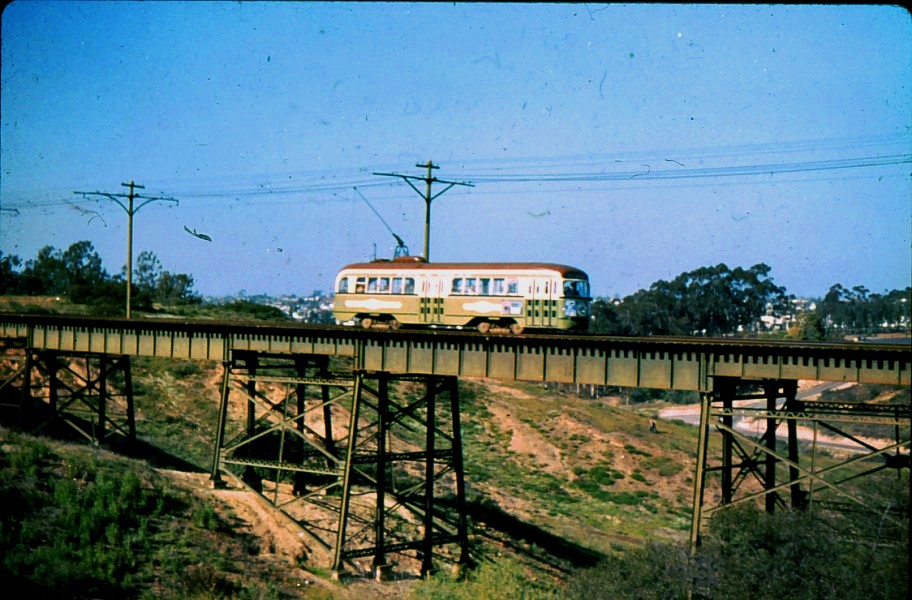
By the 1930s, however, streetcars in San Diego and across the nation were in trouble. As private cars and city buses began to take over the business of street railways, the Electric Railway President’s Conference Committee began work on a streamlined art-deco streetcar that would get passengers back on track. This was the PCC (President’s Conference Committee) car, and although it failed its mission of saving the streetcars entirely, it became an icon of American cities from Philadelphia and Boston to San Francisco and San Diego, and set the stage for future technological developments in European trams and, later, modern American light rail networks.
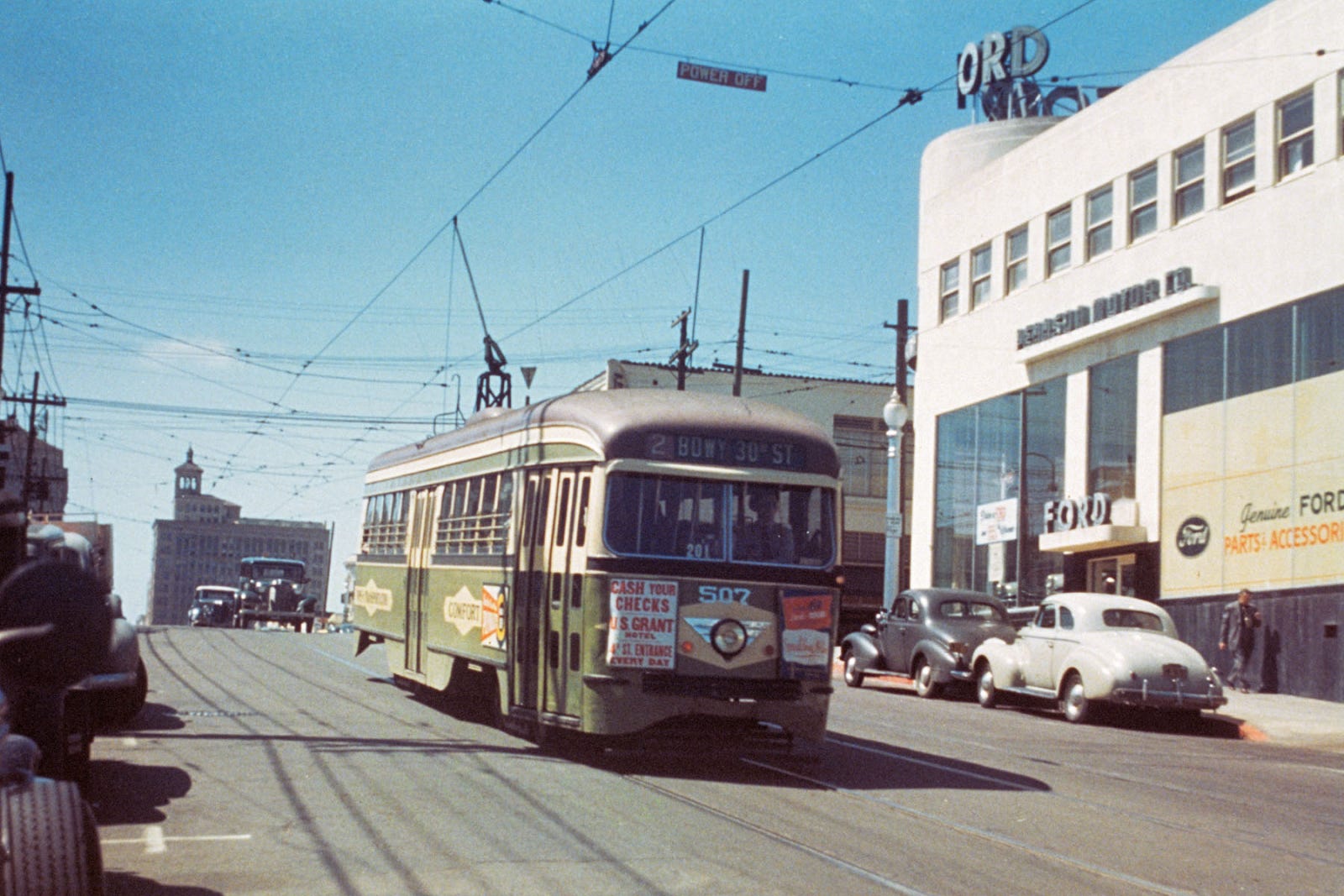
An SDERy PCC travels eastbound on Broadway in the late 1940s. (MTS Archive)
The PCCs were sleek, streamlined, and initially very successful in attracting passengers back to the SDERy. The first line to fully be converted to PCC operations was car line no. 3 along 5th Avenue, with service on lines 1, 2, 7, and 11 converted to PCCs in years to come. The chrome-plated “wings” around the headlights and the rounded indoor lamps gave the PCC an art-deco appearance, while San Diego employed a bold green-cream-and-brown livery with various texts reading “RIDE & RELAX” and “TOPS FOR TRANSPORTATION” - and, on some cars, “COMFORT” or “SAFETY.”
In all, San Diego ordered a rather small number of PCCs (28, split between a first order of 25 and 3 additional cars delivered later), with the first being ordered in 1936. This made San Diego the first operator in western North America to order and take delivery of PCC cars.3
However, even as the PCCs were being introduced across the nation, the streetcar era was already winding down. It took librarians at LA Metro’s Transportation Research Library and Archive years to discover that, in footage of then-child star Shirley Temple inaugurating Los Angeles’ PCC cars, a dignitary boards the streetcar while saying “Shirley, buy yourself a new automobile.”4 Even as Los Angeles heralded its PCCs as “the latest in big-town transportation on rails,” streetcars were on their way out. In 1949, San Diego became the first city in North America to completely abandon the streetcar in favor of the humble city bus.
The complex history of the PCCs gives them an air of universal nostalgia. Even as someone far too young to have ridden the PCCs in San Diego revenue service, the rapid rise and fall of these little streetcars and the systems they represented has long fascinated me and many other transit enthusiasts. This nostalgia, combined with high costs for replacement vehicles, has led many systems to establish heritage corridors, like SFMTA’s F Market or the MBTA’s Mattapan Trolley.
Here in San Diego, the Silver Line Vintage Trolley circles downtown on select holidays, alternating between PCC car #529 and the original 1980 San Diego Trolley (“U-2” car #1001). The history of the Silver Line is almost as unique and complex as the history of the PCC cars themselves: originally built in 1946 for the St. Louis Public Service Company, car #1716 was transferred to the SFMTA, where it became car #1122. After years of service in San Francisco, it was sold to a private collector in South Lake Tahoe, who let it rust in the hopes of someday building their own private trolley line.
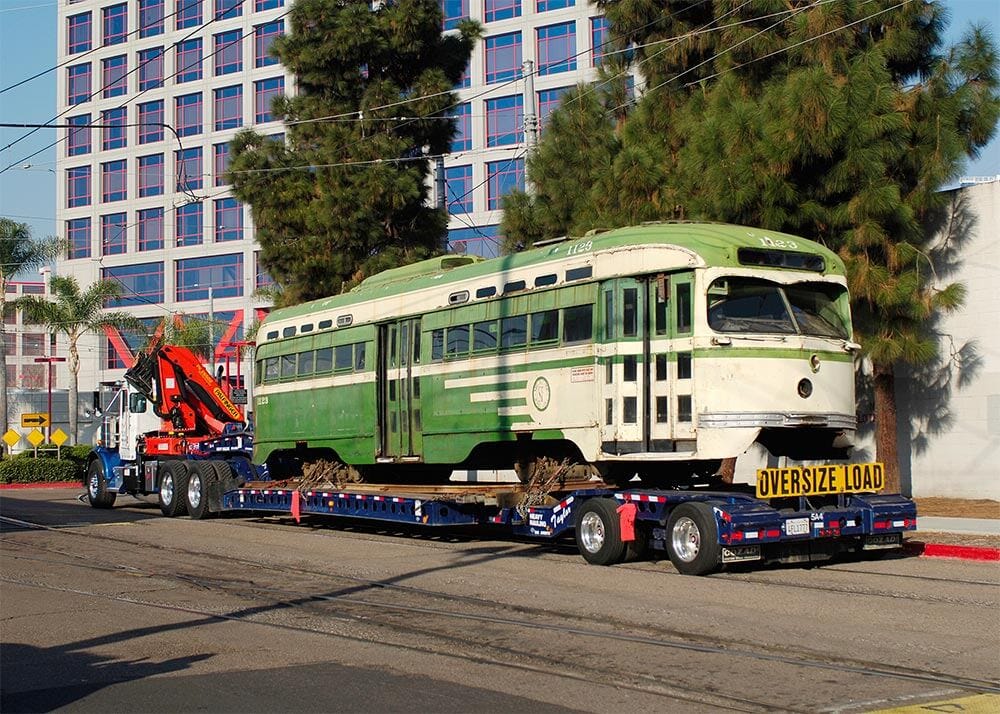
Car #1122 upon arrival to San Diego, in San Francisco Municipal Railway colors. (MTS)
In December 2005, MTS purchased the first of two PCC cars from the collector. By 2010, MTS had acquired a total of five cars (ex-Muni and ex-Philadelphia Rapid Transit) for Vintage Trolley service around downtown San Diego. A dedicated team of volunteers worked to restore the car to match a SDERy PCC car, with it being renumbered car #529 and turned over to MTS in early 2011. The final PCC car to be delivered to the SDERy was car #528.5
Silver Line hours have varied over the years: at one point, Vintage Trolley ran several days a week, but reliability issues and added revenue service forced operating hours to be reduced to weekends only, then to select holidays and “heritage weekends.” Then, after around September 2023, the PCC stopped running, with car #1001 left as the sole rolling stock of the Vintage Trolley. Apparently, it was a mechanical issue that led to this move, with the motor on car #529 requiring a complete replacement. Now, after two years, the PCC has made its triumphant return to San Diego’s streets once again. Full Vintage Trolley holiday service has resumed, with the PCC completing a full day of in-service moves just a few days ago on November 30th, 2025.
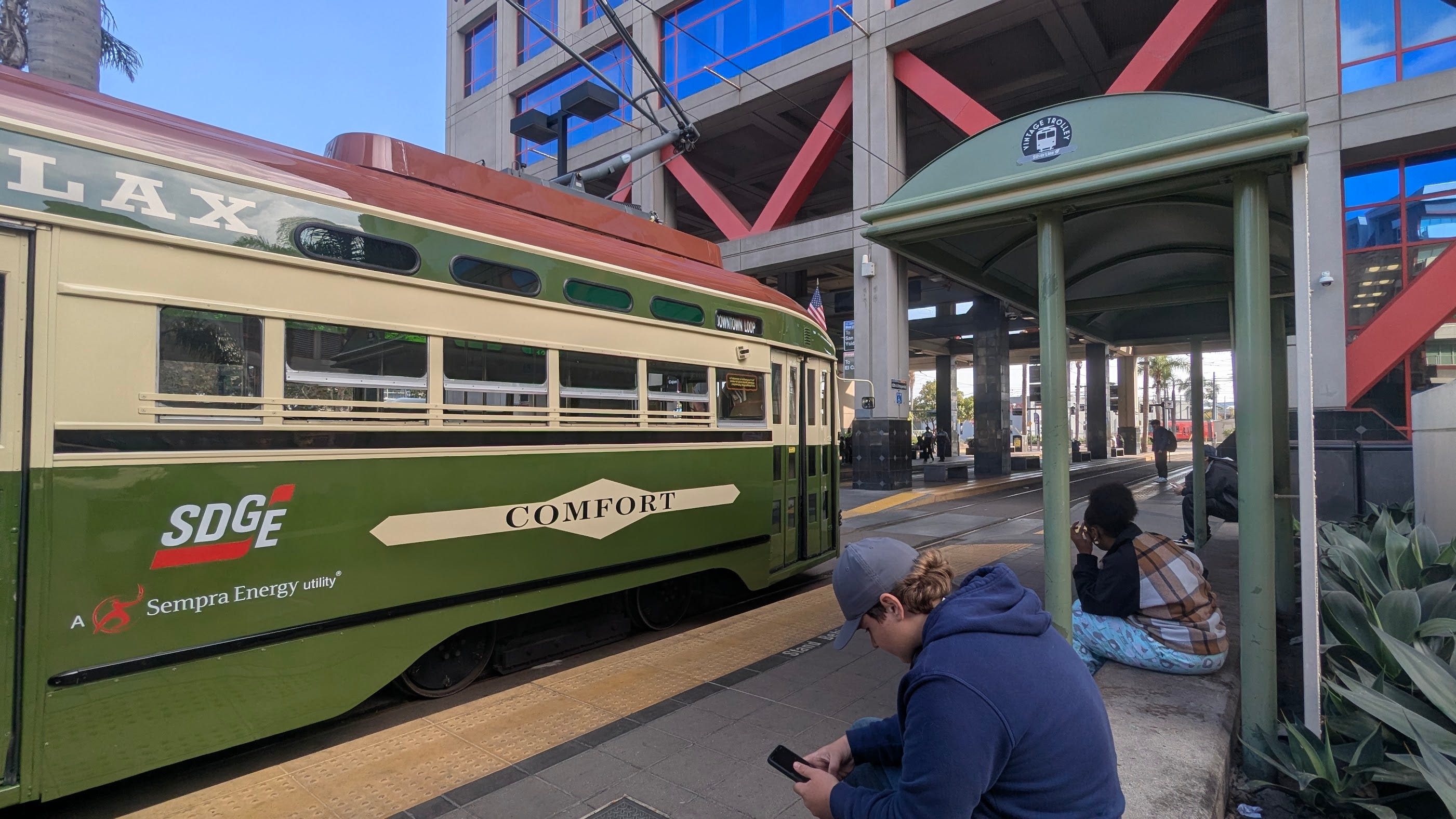
The PCC car waits at 12th & Imperial. (Samuel Sharp / The SoCal Transiteer)
Watching Trolley supervisor Josh Harris get in the driver’s seat and make this nearly 80-year-old piece of machinery move invoked a new kind of nostalgia within me. Harris is no stranger to operating strange rail equipment - he competed in the World Tramdriver championships in Vienna earlier this year - but it was clear the entire MTS crew saw something special in the PCC. There was a collective sense of relief that this car was road-tested and running once more, ready to create generations of new transit fans and railroad historians.
And it all started with the rise and fall of Mr. Spreckels’ street car.
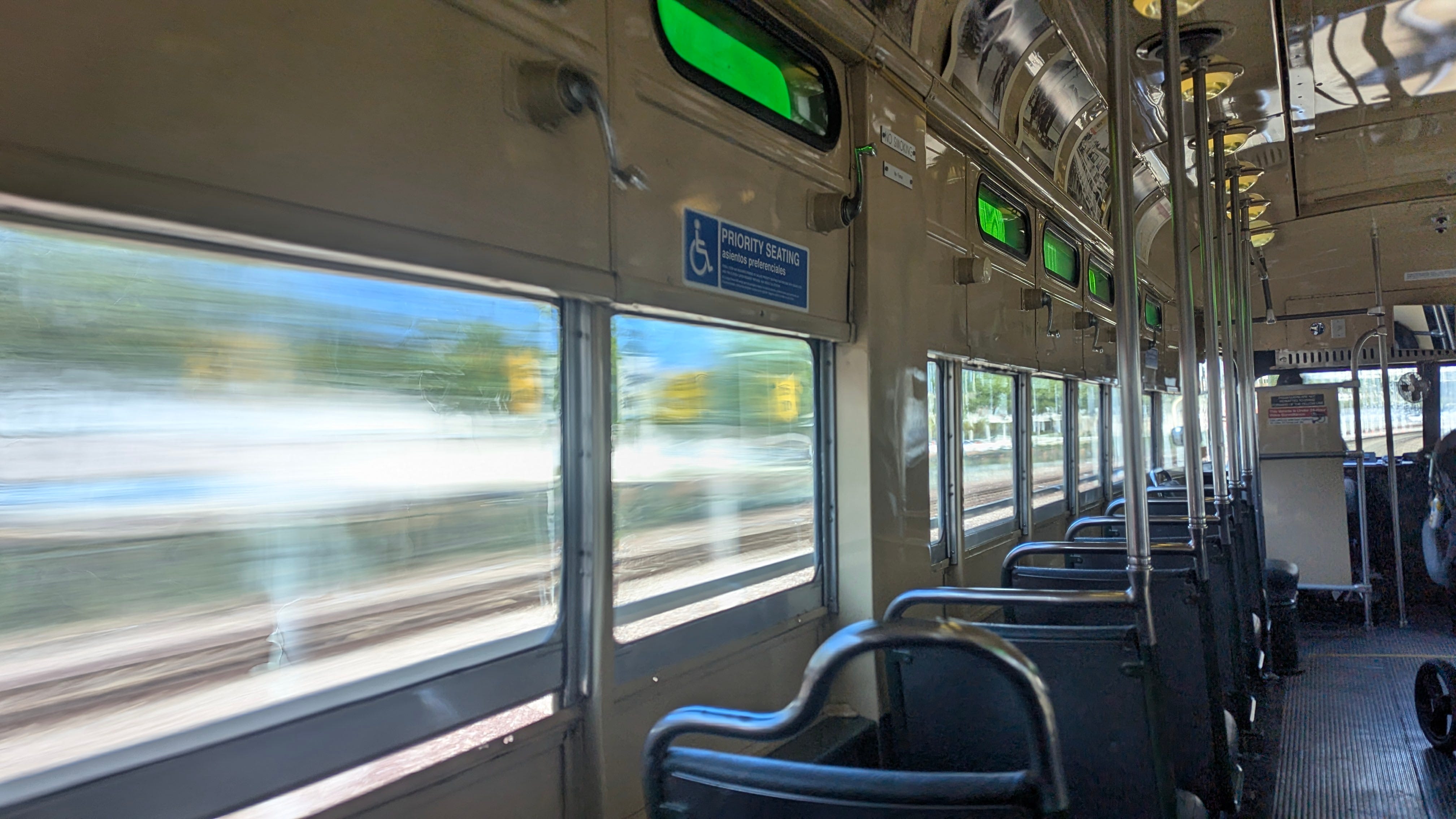
Car #529 speeds along the Bayside Line (Samuel Sharp / The SoCal Transiteer)
This piece was originally published in the incredible SoCal Transiteer!
Footnotes
-
1 - J. Harold Peterson, The Coronado Story (1959) ↩
-
2 - Look up “the impossible railroad” and thank me later. ↩
-
3 - P. Allen Copeland, San Diego and the PCC Streetcar (2011) ↩
-
4 - From the Metro archive: https://metroprimaryresources.info/at-l-a-s-streetcar-inauguration-who-told-8-year-old-shirley-temple-buy-yourself-a-new-automobile/6528/ ↩
-
5 - P. Allen Copeland goes into far more detail on the acquisition and restoration in San Diego and the PCC Streetcar, along with detailed technical specs of the PCC cars. ↩