
San Diego’s BRT experiments, 11 years on
How are the promises of Rapid holding up?
 06.29.26
 Benji Comiskey, Projects Co-Editor
For over a decade now, MTS Rapid has been an ambitious project to bring high-frequency, limited-stop bus service throughout the county, filling in the gaps where Trolley service might be too costly. In theory, the network is bus rapid transit (BRT), a term intended for fast, high-capacity, high-frequency, and limited-stop network of bus lines typically built as a lower-cost alternative to an urban rail system. However, today’s Rapid network looks more like an eclectic mix of neighborhood circulator, commuter express, and standard arterial bus routes. While these lines do incorporate some BRT technology, many still fall short of ‘true’ BRT.
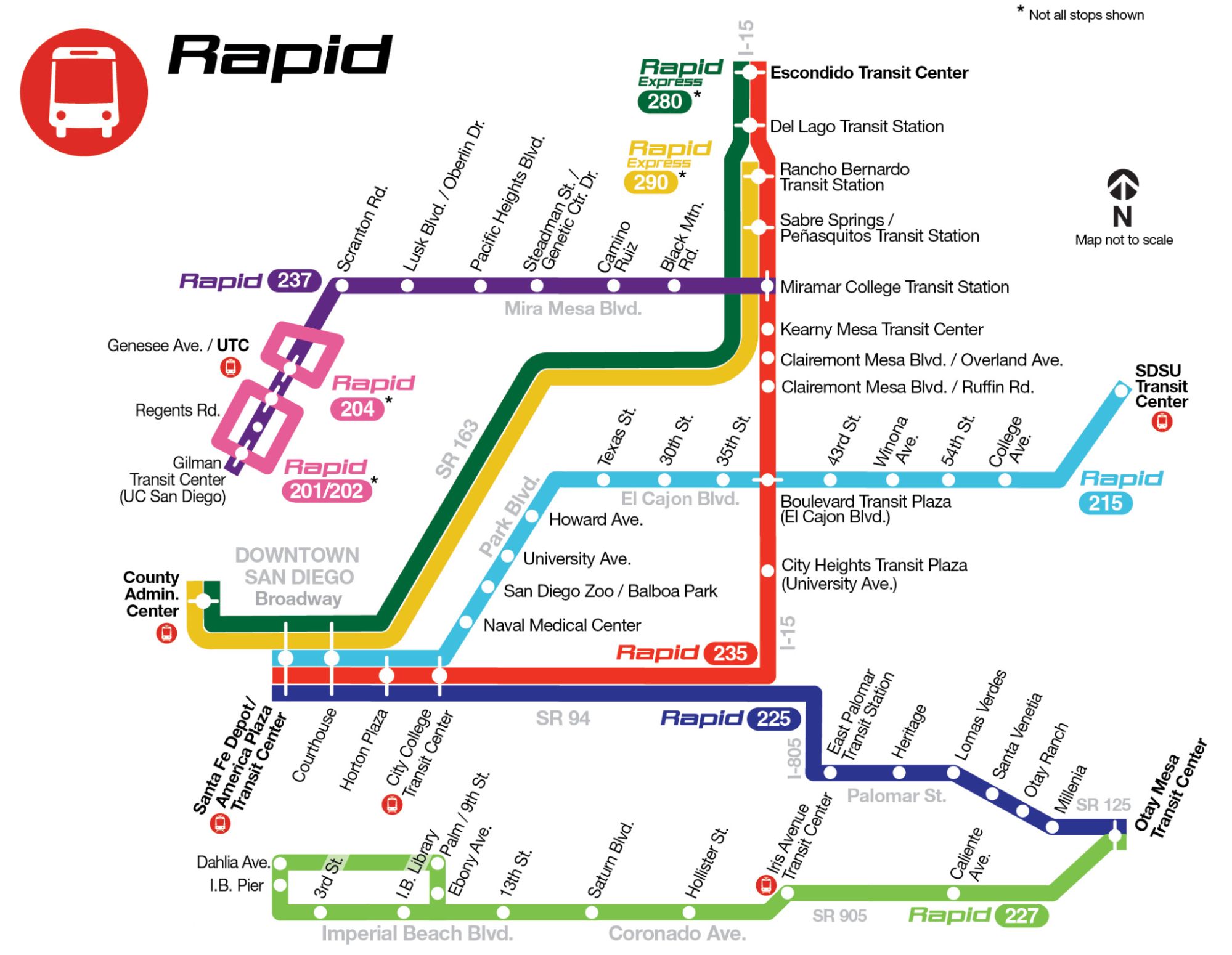 Map of the Rapid network (MTS)
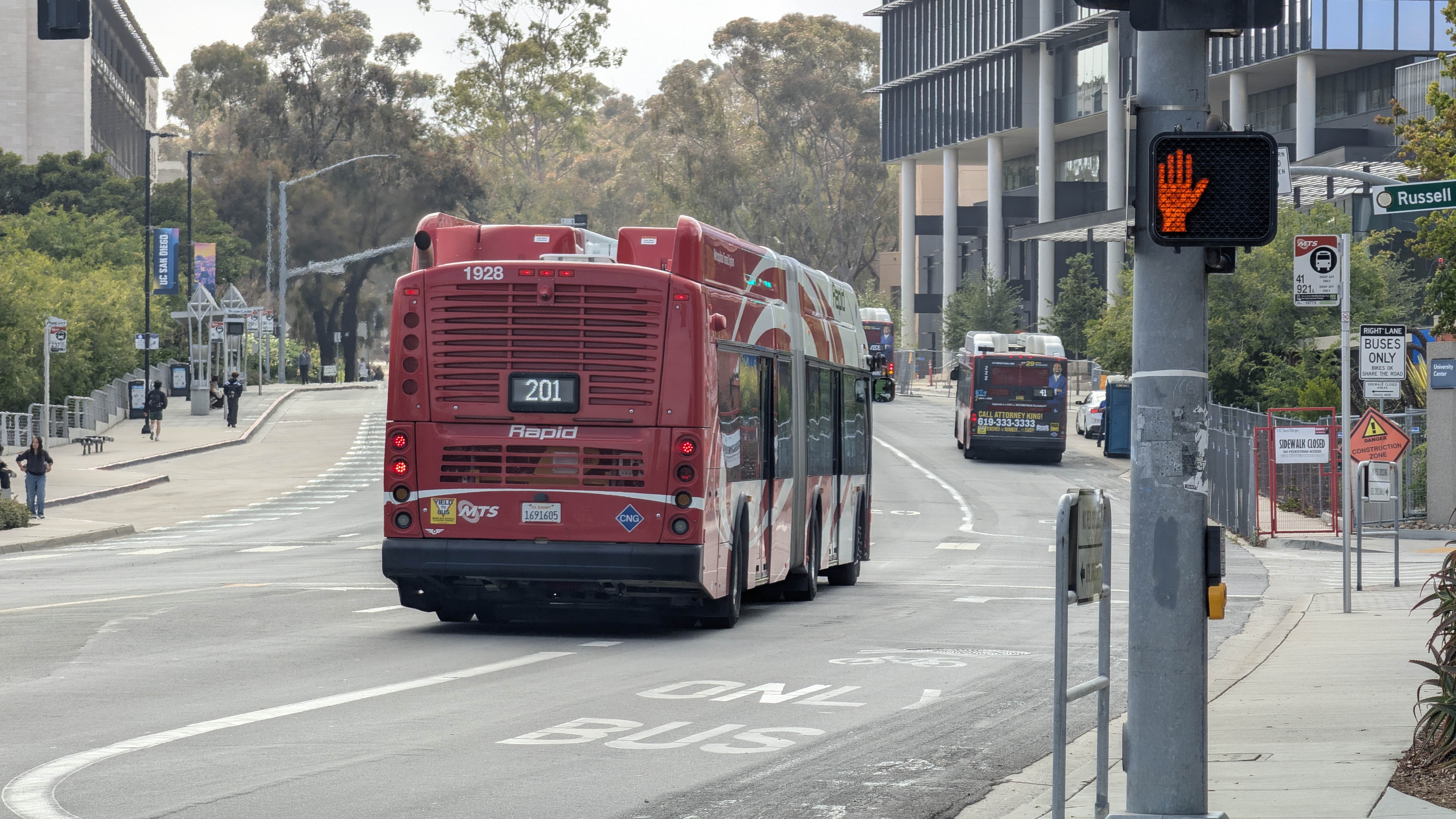
For example, Rapid SuperLoop 201/202, is a bidirectional loop around the University City area between UTC and UC San Diego. Frequencies are very high — every 5-10 minutes during weekday base hours alongside intersections equipped with transit signal priority (TSP), and enhanced bus stops with wayfinding signage and variable message screen (VMS) monitors displaying scheduled next buses . However, the distance between stops is relatively small, roads lack bus lanes, and the enhanced bus stops do not feature safety lines or raised platforms. While SuperLoop isn’t bad by any stretch — it is the highest-ridership MTS route — it might be better to once again brand the route exclusively as SuperLoop.
Rapid Express 280 and 290, while part of the same Rapid brand, are polar opposites to the 201/202: peak-only commuter express routes which use over-the-road (OTR) coaches instead of standard transit buses. The routes complement Rapid 235 but serve fewer stops along the way, with Rapid 280 only serving Rancho Bernardo, Del Lago, and Escondido and Rapid 290 only serving Miramar College and Sabre Springs. While these routes make use of express lanes on I-15, the routes only operate at rush hour, southbound towards downtown in the morning and northbound towards Escondido in the afternoon. This creates efficiency issues for the agency because it requires the dedicated fleet of OTR coaches to be ‘deadheaded’ to and from their termini, a process during which they cannot generate any revenue or ridership. Additionally, the dedicated fleet of OTR coaches, which are used nowhere else on the network, create an additional maintenance burden for the agency.
This is the core quandary of Rapid: it doesn’t necessarily know what it wants to be. Another example of this phenomenon is how Rapid 225 service attempts to operate as both a freeway express and an urban BRT route, operating along a 5-mile dedicated busway in Otay Ranch before running express for 11 miles between the East Palomar Transit Station and Downtown San Diego. While beneficial to peak-hour commuters, the route’s mixed service forfeits connections between the communities along the express portion of the route, and means the route misses a connection to the Orange Line Trolley at 47th Street Station. Additionally, such a long express segment continuing to operate during mid-day hours when few people are headed downtown hurts base service frequency across the rest of the route. Rapid 225 only runs every half-hour during base hours, perhaps a headway acceptable for a commuter express, but not for local rapid transit along the busway in Otay Ranch. SANDAG and Caltrans originally proposed adding three inline stations along I-805 and SR-94 similar to those on Rapid 235 in City Heights, though these stations have never been built.
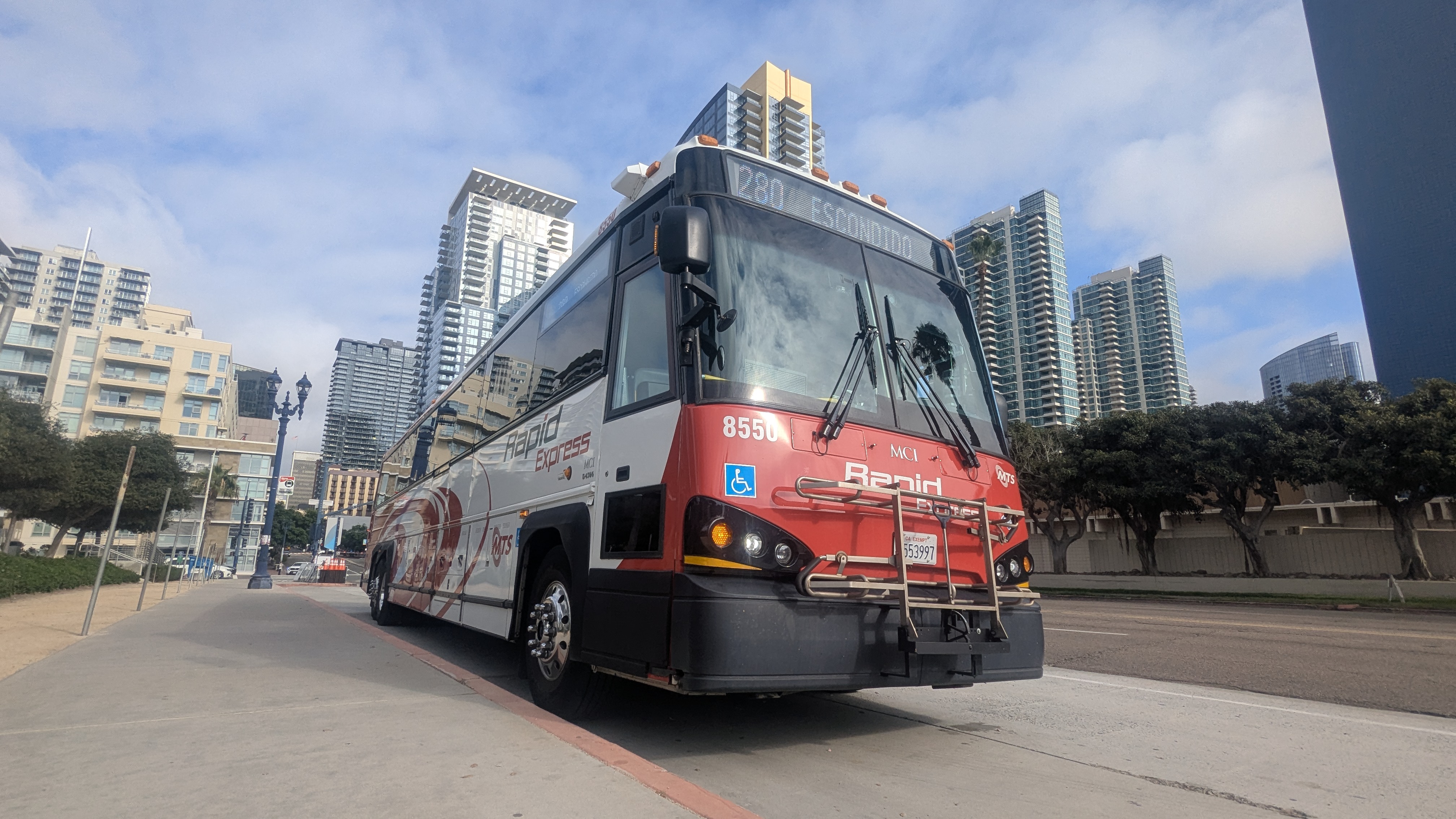 A Rapid 280 motorcoach on layover at the County Administration Building (Samuel Sharp / BuildSD)
The availability of dedicated infrastructure also varies throughout the network. Rapid 225 uses both a five-mile busway and HOV lanes on the I-805. Intersections along the busway are equipped with TSP. SuperLoop 201/202 and Rapid 215 also feature limited TSP. Bus lanes on Rapid are a relatively recent addition. Rapid 235 saw bus lanes installed when the City Heights and Boulevard Transit Plazas opened in 2018. Rapid 225 was next when it and its five-mile busway fully opened in 2019. Finally, alongside its original half-mile-long busway along Park Boulevard, Rapid 215 saw the opening of the Boulevard Bus Way in 2020 after many years of fighting with business owners.
Station amenities also vary. In Downtown and Kearny Mesa, most Rapid stops are simple streetside stops used by local bus routes, albeit with an additional Rapid bus blade. Some more advanced stations such as at Clairemont Mesa Blvd & Ruffin Road, East Palomar Transit Station, and at various points along El Cajon Boulevard may include upgraded shelters, route wayfinding signage, and VMS monitors with next bus times. In some cases, such as at Rancho Bernardo and Del Lago Transit Stations, Rapid buses use off-street bus loops.
Like on MTS Urban and Rural network buses, each vehicle has a PRONTO scanner for quick and easy payment. However, most stations lack ticket machines that would give riders a PRONTO card to pay with. While the introduction of credit/debit card open payment might be helpful, riders without a PRONTO card will have to spend extra time paying with cash or using the mobile app. Additionally, Rapid was originally planned to feature all-door boarding, where riders would be able to pay at validators on the platform instead of on the bus. However, this was never implemented on Rapid 215 when it began operation in 2014.
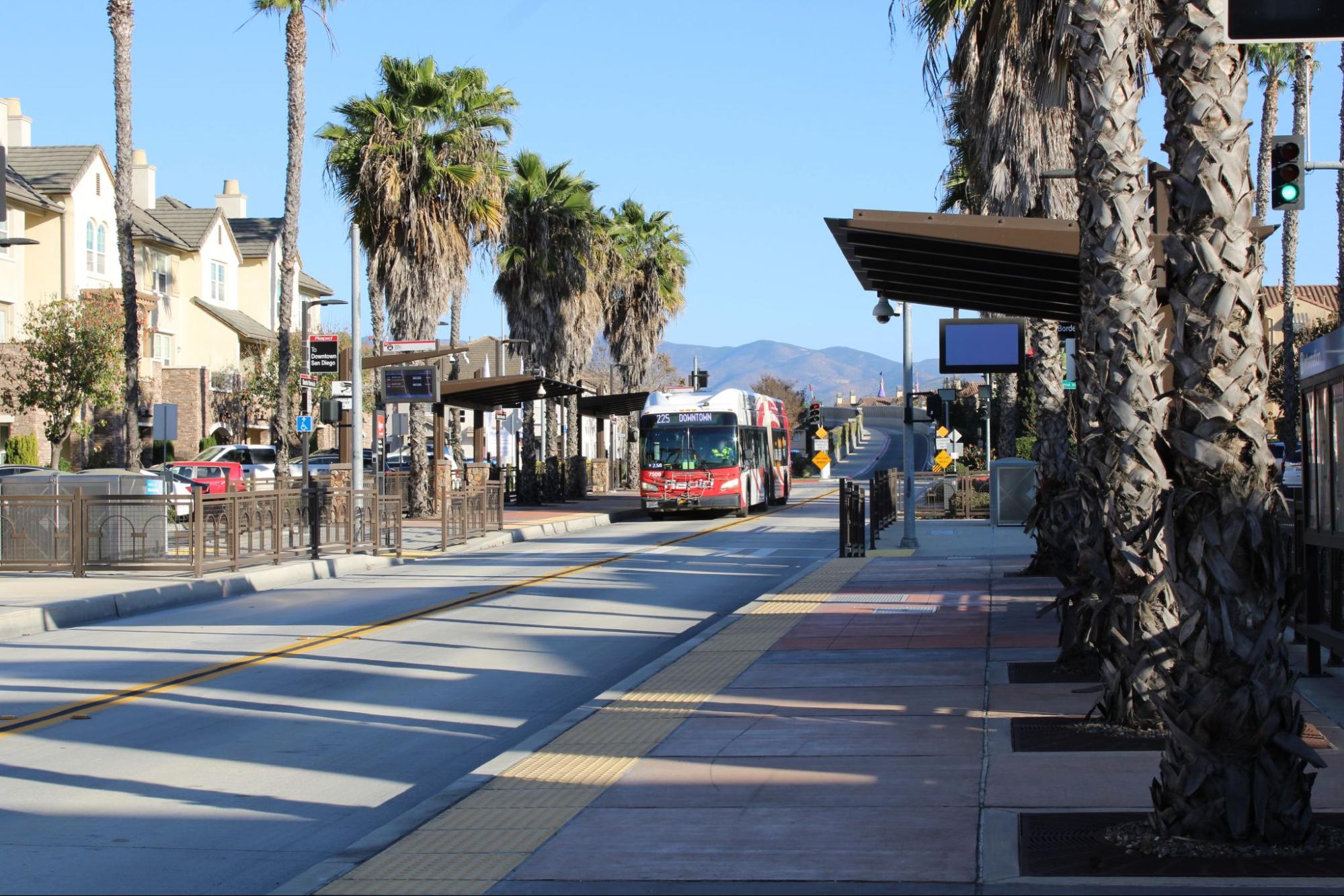 A Rapid 225 bus at Santa Venetia Station on the East Palomar Street busway (Benji Comiskey / BuildSD)
As is a theme for the Rapid network, service levels also vary throughout the network. SuperLoop 201/202 has the lowest headway (time between buses) in the MTS system with service every five minutes during rush hour, and every 10 minutes during base hours – the period between the end of morning rush hour and the start of evening rush hour. Most Rapid routes have 10-15 minute headways, such as Rapid 215, 227, and 235. On the lower end, routes such as Rapid 204 and 225 operate with 30 minute headways. Although MTS brands the Rapid network as a high frequency network, many of these lines run at very low frequencies or have gaps in span of service. Rapid 237, 280, and 290 have no mid-day service at all, only running during weekday rush hour.
Rapid covers a lot of the county, with service to destinations as far apart as Kearny Mesa, Rancho Bernardo, Mira Mesa, eastern Chula Vista, and Otay Mesa, among others. But, it also equally doesn’t serve many places. For example, Del Lago Transit Station, despite being located near North County Mall (which also has its own small transit center), is situated on the other side of I-15, reducing the station’s practicality. Transit stations like these can make up for their location through off-corridor connections, such as at Rancho Bernardo Transit Station, where riders can transfer to routes 20 and 945, serving Rancho Bernardo and Poway. However, MTS often lacks the resources to run adequate connecting service.
So that leads us back to our main question: how rapid is Rapid?
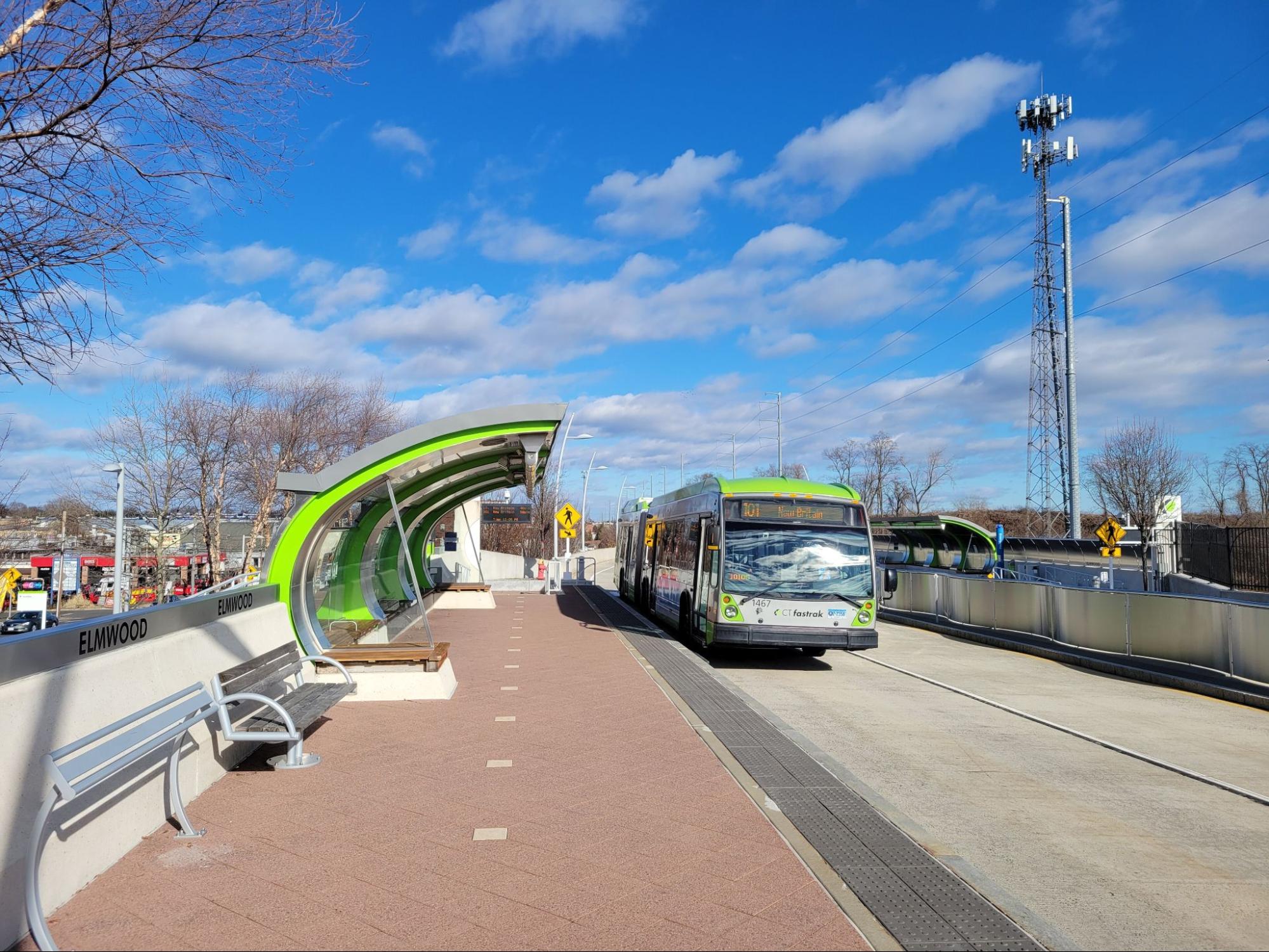 Connecticut’s CT Fastrak, ranked highest in the US by the ITDP (John Phelan / Wikimedia Commons, CC BY 4.0)
Well, a simple point of reference might seem to be the Institute for Transportation and Development Policy (ITDP)’s standards for BRT. Connecticut’s CT Fastrak bus network ranks as the highest-rated BRT system in the country according to the ITDP standard, running across a nine-mile, mostly grade-separated, dedicated busway between New Britain and Hartford, taking roughly 30 minutes. While Fastrak features dedicated stations, level boarding, offboard payment, and peak frequencies of every seven minutes on its main route, poor land use near stations and the suburban character of much of the route dilute the necessity of BRT amenities, and the network must rely on deviations off the busway to reach many popular destinations. In San Francisco, the Van Ness BRT corridor provides a central spine for multiple bus routes, using dedicated bus lanes and TSP along Van Ness Avenue to keep buses moving.
San Diego’s network, on the other hand, is incomplete and inconsistent — BRT infrastructure and technology may be completely absent across most of or all of a line, and the quality of service varies wildly across the network. However, the investments already made into the Rapid network so far are certainly good ones. It has brought high-frequency transit services to many communities across the county which once lacked them. Rapid lines have been used as an example to other cities, such as in Atlanta, where the Atlanta Regional Commission cited Rapid 225 as an example of how BRT could make transit expansion cheaper and easier.
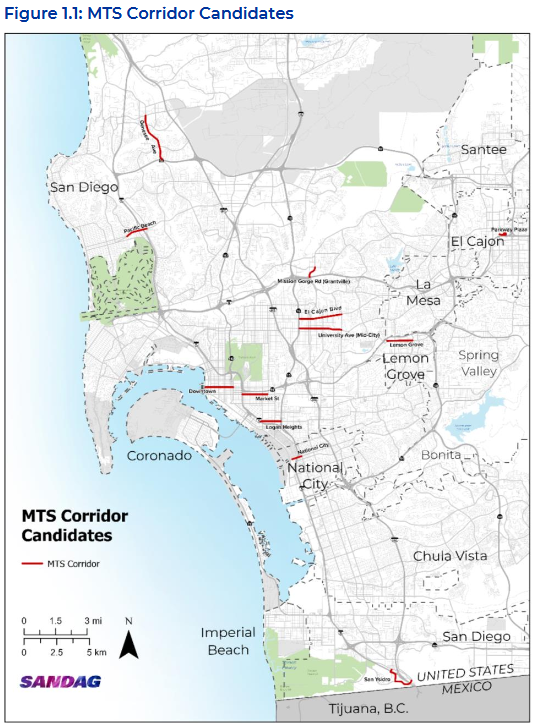 Quick-build corridor candidates as of February 2026 (SANDAG)
There are also efforts to expand bus lanes across the Rapid network. Bus lanes have recently been added along Park Boulevard in Balboa Park to speed up Rapid 215 through the busy destination. In Downtown, where many Rapid routes travel along Broadway, the lack of bus lanes and TSP at intersections also slows buses down greatly. SANDAG has identified Broadway as a top-priority “quick-build” BRT corridor, meaning that bus lanes and TSP could be rolling into Downtown soon. SANDAG has also identified the section of El Cajon Boulevard east of I-15 as a candidate for bus lanes. However, despite some community advocacy, this project has been deprioritized amid concerns that it would constrict traffic by reducing the existing four-lane street into a two-lane one.
In the long-term, planners seem to have taken past oversights into account. As part of SANDAG’s Next Gen Rapid project, the new Rapid route 625 will feature mostly dedicated lanes and TSP across almost all of its route, alongside plans for level boarding, offboard fare payment, and enhanced stations on other Next Gen Rapid routes. At the same time, it’s important to remember that the original Rapid 215 was planned with many of these improvements in mind, and yet opened with none of them.
SANDAG also needs to invest in operations on future Rapid routes, instead of leaving MTS with the ability to only offer mediocre service. Alongside adding bus lanes, dedicated stations, and all-door boarding, it is equally as imperative to ensure buses run more often, run for longer, and are able to serve important destinations efficiently. Simply put: if we want our bus rapid transit system to be good, we have to start treating it like rapid transit. And with major service changes on the horizon (for better or for worse), there’s no better time to complete the Rapid network than now.