
Voter Guide: 2026 General Election
 10.19.26 // Election Day is November 3, 2026!
 BuildSD Staff
This voting guide outlines BuildSD’s positions on selected state and local ballot measures, explaining how each could affect our communities, public services, and the future of development in California. Our goal is to help San Diegans make informed decisions that support a more prosperous, accessible, and vibrant region.
BuildSD supports measures that advance housing opportunities, strengthen communities, invest in future generations, and promote responsible long-term planning, and we reject measures that make it harder to support communities and essential services. We encourage voters to look beyond the ballot language, understand the long-term implications of each measure, and consider how their decisions will shape the future of our communities.
YES on Proposition 1: Affordable Housing Bond Measure
Proposition 1 asks voters to authorize a $11.25 billion general obligation bond to fund programs that support the creation and preservation of affordable housing, expand homebuying opportunities for low-and moderate-income Californians and veterans, and invest in permanent solutions to solve homelessness.
Voting YES on Proposition 1 would help California address its housing affordability and homelessness crises by investing in affordable housing, expanding homeownership opportunities, and funding long-term solutions to homelessness. The $11.25 billion bond would provide resources to build and preserve affordable homes, help low- and moderate-income families and veterans achieve homeownership, and expand access to supportive housing and behavioral health services for people experiencing homelessness. By investing in housing and long-term solutions rather than relying solely on short-term interventions, Proposition 1 would help create more stable communities, improve quality of life, and address some of California’s most pressing challenges.
 Photo by Samuel Sharp / BuildSD
YES on Proposition 2 – California’s Rainy Day Fund
Proposition 2 would expand California’s Rainy Day Fund, originally approved by voters in 2014, to help maintain funding for education, health care, public safety, and other essential services during economic downturns.
California’s state budget is highly volatile because the state relies heavily on capital gains tax revenue, which is collected on profits from selling investments, such as stocks. This revenue fluctuates with the stock market, making it difficult to maintain a balanced budget.
In 2022, California recorded a historic $97.5 billion budget surplus. However, the state soon faced significant budget shortfalls, with a deficit of approximately 22.5-27 billion in the 2023–2024 fiscal year and an estimated $68 billion deficit in 2024–2025. These dramatic swings from surplus to deficit highlight the challenges of managing California’s finances and the importance of maintaining reserves to help stabilize funding for essential public services during economic downturns.
For these reasons, voting YES on Proposition 2 would help California better prepare for future economic downturns by strengthening its financial reserves. By setting aside more funds during periods of economic growth, the state can reduce the need for sudden budget cuts when revenues decline. This helps protect essential public services, including housing and mobility programs, while providing greater stability for California’s budget. Proposition 2 is a step toward more responsible, long-term fiscal planning that benefits all Californians.
 Photo by Samuel Sharp / BuildSD
NO on Proposition 42 - Prohibit New State Personal Property Taxes
Proposition 42 would prohibit any new state tax (1) imposed on the ownership of personal property (all things people own other than real estate), or (2) that applies retroactively based on taxpayer’s past activities. Nullifies taxes enacted after January 1, 2026 that conflict with this measure.
Voting NO on Proposition 42 would preserve California’s ability to respond to changing economic conditions and address future budget needs. By prohibiting new taxes on personal property and taxes applied retroactively to past activities, the measure could limit the state’s flexibility to develop future revenue sources.
It could also restrict policymakers from adjusting tax policies to address emerging economic challenges or ensure that those with greater financial resources contribute fairly. Rejecting Proposition 42 would allow California to retain the flexibility to make tax and budget decisions based on the state’s evolving needs, while maintaining the ability to fund essential public services such as education, health care, and public safety.
NO on Proposition 43 - Limits Voters’ Ability to Enact Revenue Measures
Proposition 43 would limit voters’ ability to pass voter-proposed local special taxes by increasing the percentage of votes needed to approve such ballot measures from a majority (over 50%) to two-thirds, beginning January 1, 2027.
Voting NO on Proposition 43 would protect the ability of local communities to fund essential services and infrastructure through the democratic process. By increasing the voter approval threshold for local special taxes from a simple majority to two-thirds, the measure would make it significantly harder for communities to invest in priorities such as public transit, parks, libraries, affordable housing, and public safety. Many local projects depend on voter-approved funding to address specific community needs. Rejecting Proposition 43 would preserve the majority-vote standard, ensuring that local residents retain a meaningful voice in deciding how their communities invest in public services and infrastructure.
 Photo by Samuel Sharp / BuildSD
Proposition 45 - Modifies Environmental Review for Certain Projects
Proposition 45 would amend the landmark California Environmental Quality Act (CEQA) to expedite environmental review for ‘essential’ projects: housing, transportation, most utilities, health, schools, police and fire stations, and clean energy infrastructure. The proposition would create deadlines to complete environmental review and resolve lawsuits challenging project approvals. The deadline for a CEQA review to be completed would be at most 365 days for an EIR, 180 days for a negative declaration or mitigated negative declaration, and 90 days to be notified the application is considered complete and the review is underway. If a correction is needed for a project application to comply with CEQA, corrections can be made and the CEQA application can be corrected. Currently, the entire CEQA application must be processed again. CEQA based lawsuits on these essential projects would have to be completed within 270 days, with a 90 day extension if necessary.
BuildSD has no recommendation on Proposition 45. However, we encourage our members and readers to understand the arguments for and against and make their own decision. Proposition 45 raises an important question about how California can balance the need to accelerate housing and infrastructure development with the responsibility to protect the environment and maintain public oversight. While streamlining project approvals could help address development delays, the changes Prop 45 is proposing could affect how environmental impacts are reviewed and how communities can participate in the process.
 Photo by Samuel Sharp / BuildSD
Potential Benefits: Proposition 45 could help California deliver much needed housing and infrastructure by reducing lengthy review periods and providing greater certainty for project timelines. Supporters argue that prolonged reviews and litigation can increase development costs, delaying housing production and essential public improvements. Lawsuits regarding CEQA applications are also common, particularly on infill housing developments. Nearly 90% of housing projects sued under CEQA were infill, not greenfield suburban development. While there is now a CEQA exemption for infill housing, it does not apply to all infill housing developments. Prop 45 also streamlines permitting on infrastructure projects in an existing right-of-way (ROW), which could substantially affect infrastructure for the planned Purple Line rapid transit project. It is also likely these streamlining measures could have sped up infrastructure for the Mid-Coast Extension of the UC San Diego Blue Line Trolley.
Potential Drawbacks: The measure would also limit certain aspects of environmental review, including the range of project alternatives agencies must consider, the time available for public comments, and the scope of evidence courts can review in legal challenges. These changes could reduce opportunities for communities to influence projects and make it more difficult to address environmental impacts before construction moves forward. The CEQA streamlining does not just apply to transit projects and infill housing. They also apply to freeway expansions and sprawling suburbs, where development would cause new pollution and/or increase vehicle miles traveled (VMT). There are also concerns that data centers might be included depending on how Prop 45 is interpreted, the same issue applies to other categories such as "essential water infrastructure” which likely includes desalination plants and new water reservoirs, which are often incredibly controversial developments.
BuildSD recognizes the need to streamline development and accelerate the delivery of housing and infrastructure throughout California. However, Proposition 45 presents a broader set of changes to environmental review and public oversight that extend beyond simply reducing delays. Given the potential benefits of faster project delivery and the concerns surrounding environmental protections, community input, and local agency authority, BuildSD makes no recommendation on Proposition 45 and encourages voters to consider both its potential advantages and trade-offs.
Further reading on Proposition 45 from: California YIMBY, Streetsblog San Diego
YES on SDUSD Measure M - Public School Facilities & Safety Bond
Measure M would authorize up to $3.5 billion in bonds to fund the construction, renovation, and improvement of public school facilities. The bonds would be repaid by extending the existing property tax rate of $32 per $100,000 of assessed value for an additional 10 years.
BuildSD believes that investing in the next generation is essential to building a stronger San Diego. Voting YES on Measure M will help provide local students with safer and more modern facilities. By investing in our schools today, we are investing in the future of our children and the long-term prosperity of our communities.
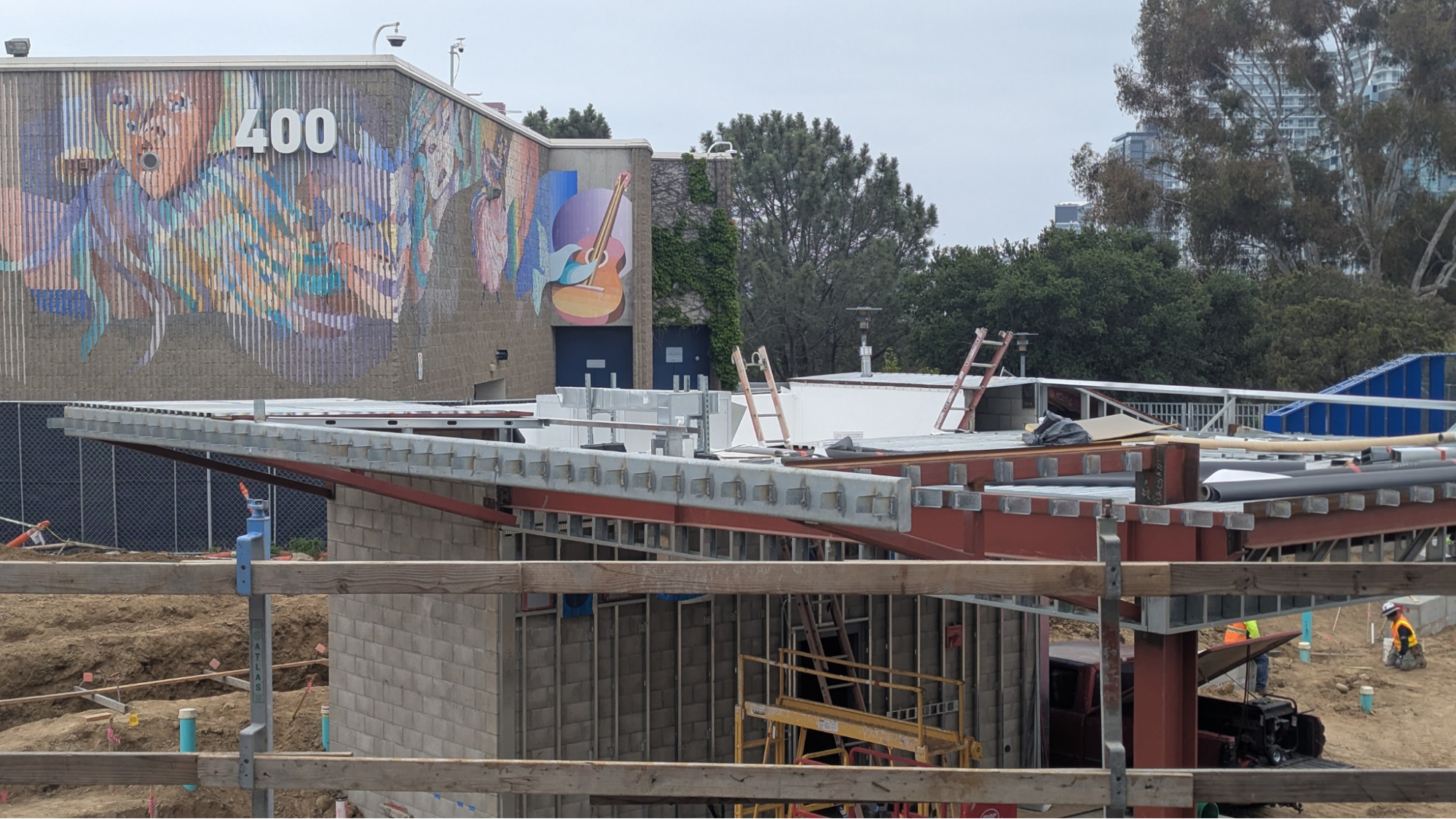 Work progresses on the San Diego High School Whole Site Modernization (WSM) project (Samuel Sharp / BuildSD)
Even if you disagree with many (or all) of our recommendations, we want you to vote! Election Day is November 3rd, so please register to vote and make a plan to vote safely before or on Election Day. All voters are mailed a ballot, which can be returned via mail or ballot drop boxes located across San Diego County. You can also vote early or on Election Day at a vote center or at the Registrar of Voters’ office in Kearny Mesa.
One last word to the wise: if you “don’t do politics” or don’t think anything this election is “worth voting for,” you are wrong. The issues you care about are on the ballot, usually directly, and voting lets you help decide the future of California!