SB 79 Deconstructed: Lemon Grove
 09.28.2026 // When life gives you lemons… mix your Downtown Plan Update and SB 79 plan together?
 Maxwell Gergen, Vice President & Advocacy Lead
 Ethan Paul, President & GIS Lead
 Samuel Sharp, Editor-in-Chief
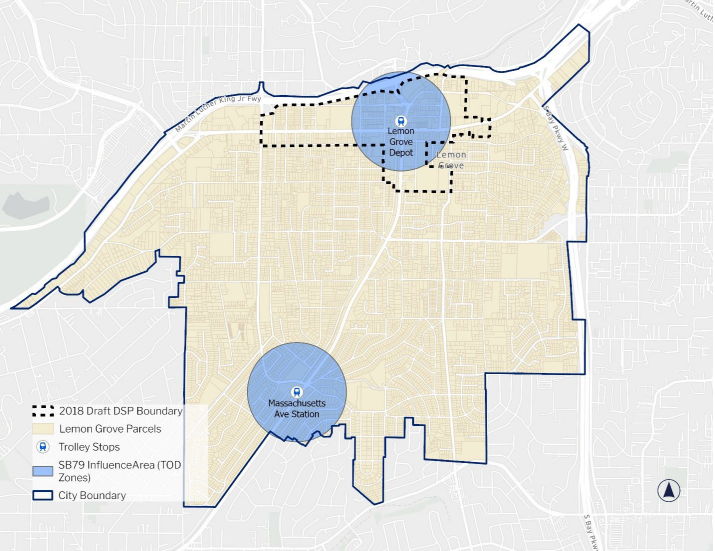
Lemon Grove is one of the smallest cities in San Diego County, and the second smallest (by population) served by a station that qualifies for SB 79, which provides for upzoning near major transit stops. They have created a TOD (Transit-Oriented Development) alternative plan, which is the legal document that specifies which SB 79-allowed density shifting and exclusion measures a city plans to enforce, unusually quickly – becoming only the fourth city in San Diego County to do so.
At the same time, Lemon Grove is undergoing a Downtown Plan Update. If adopted, it would be their first since 2005. This plan update also has the potential to guide a further revision of their SB 79 plan once adopted, so it is important to consider both together.
 Graphic courtesy of the City of Lemon Grove
Quarter-Mile Rule
Lemon Grove, as a city with less than 35,000 people, is not eligible for the half-mile TOD Zone, only the quarter-mile zone. This was a change made to the SB 79 bill text specifically so smaller cities did not have a significant portion of their area taken up by a TOD area. As Lemon Grove has 2 stations, it does have a larger zone subject to SB 79 than Solana Beach, another city in San Diego County that this rule applied to.
Mile Walk Exemption
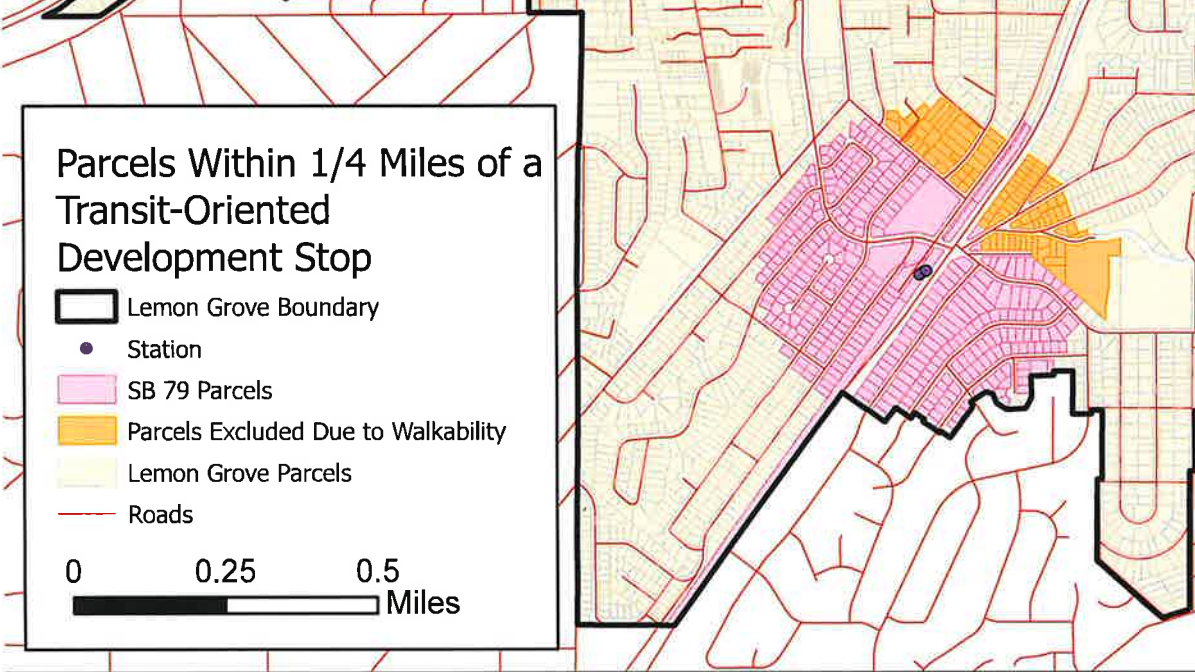
SB 79 allows cities to exempt areas within the half-mile and quarter-mile radius of a TOD stop if they are further than a one mile walk from the stop. Most cities subject to SB 79, including Lemon Grove, are using this exemption, as it prevents areas where walking to the station is not viable from being upzoned as “transit-oriented.” Seemingly, no parcels in Lemon Grove have been excluded by this exemption based purely on walking distance. However, Lemon Grove has also selectively applied it to parcels without access to sidewalks. According to city staff, they spoke with HCD and “HCD staff concurred with the City’s methodology to exempt the 95 parcels on streets without sidewalks in the Massachusetts Avenue [Station] TOD zone.”
 Map of Massachusetts Avenue Station TOD zone, orange parcels are exempt from SB 79 (City of Lemon Grove)
HCD has requested that if sidewalks are to be built near an otherwise exempted parcel, SB 79 would apply. This does give the city an odd incentive to not build sidewalks near a Trolley station if they do not want development there, as a few public commenters pointed out.
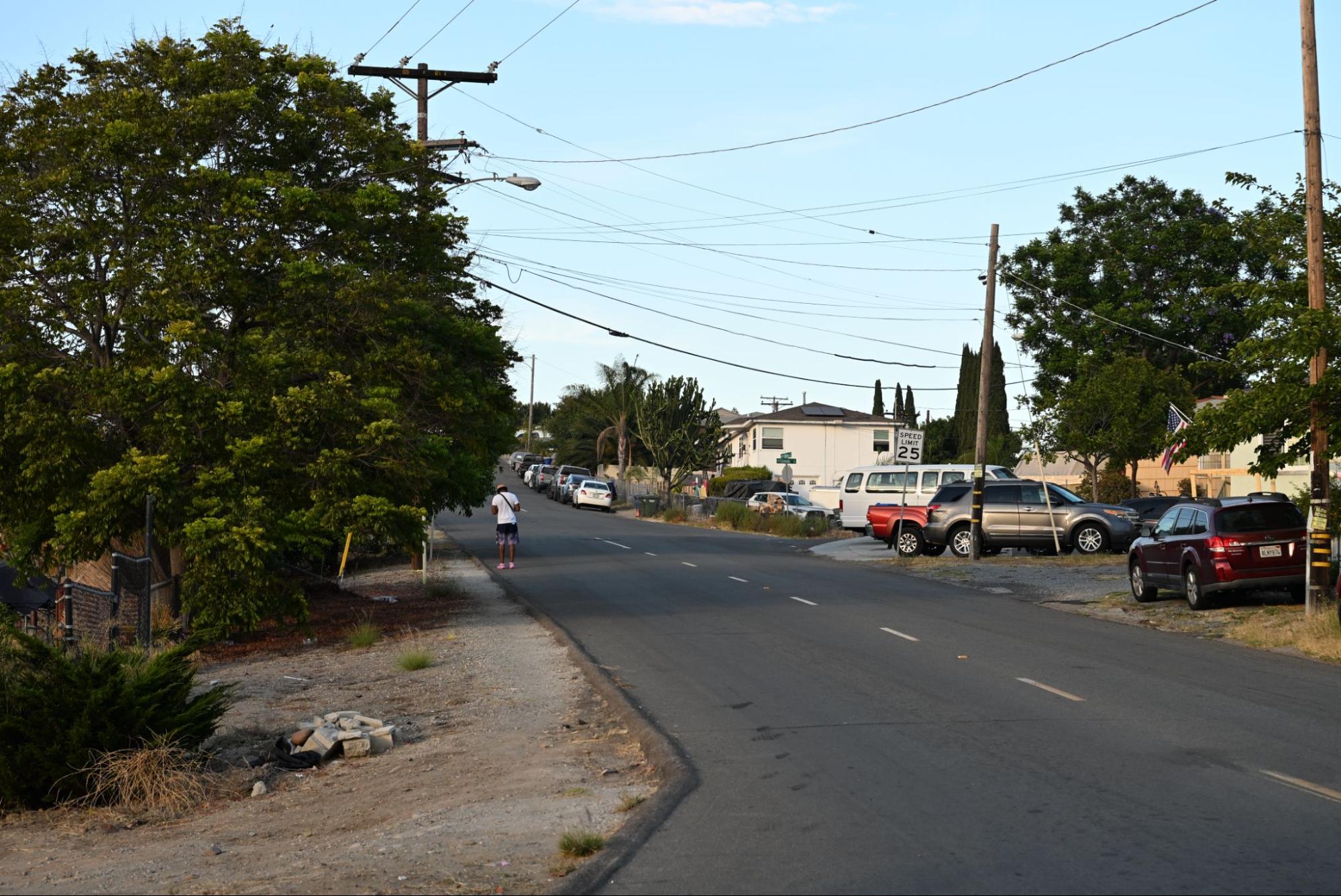 Photo by Maxwell G. / BuildSD
There are many areas in the Lemon Grove Depot station area that also do not have sidewalks, and additional areas near Massachusetts Avenue Station that have sidewalks only on one side of a road. These sites were not exempted.
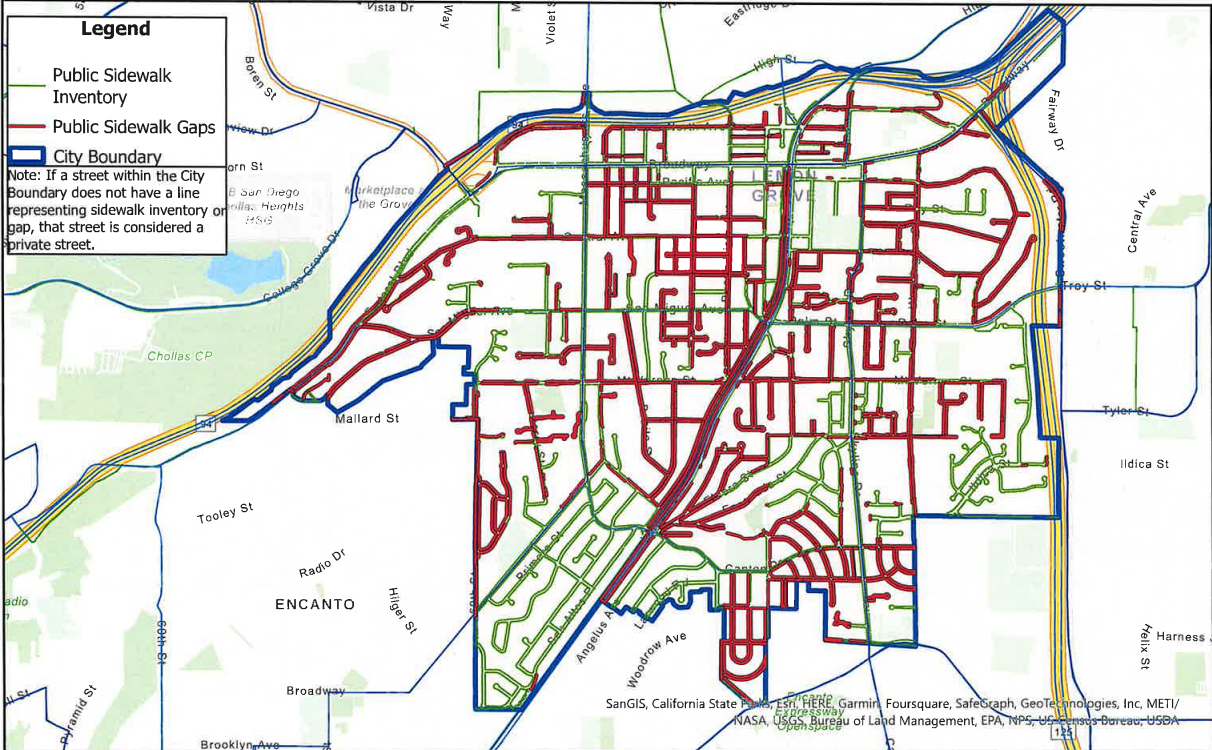 Map of sidewalk access in Lemon Grove (City of Lemon Grove)
SB 79 Zoning
The height limit of an SB 79 development is based on the station’s tier and the development’s proximity to the station. As Lemon Grove only has the quarter-mile radius rule, only two development radii apply.
Directly adjacent to a station, developments can reach up to 85 feet. This roughly equates to 8 stories. Additionally a property in this area has a floor area ratio (FAR) of 4, and 140 dwelling units per acre (DU/AC).
When not directly adjacent to a station, Lemon Grove’s tier 2 SB 79 stations allow for developments up to 65 feet. This roughly equates to 6 stories. A property in this area has a maximum floor area ratio (FAR) of 3, and up to 100 dwelling units per acre (DU/AC). According to the City of Lemon Grove, the new SB 79 zoning could house an additional if built to its whole potential 17,095 residents, and a basic projection of 30% buildout over 30 years results in 5128 new residents by the time they would likely make their next major city plan update.
Why exemptions were not available
With many SB 79 delays or exemptions, certain requirements need to be met. The ones most relevant to Lemon Grove would be delaying or exempting areas in High Fire Severity Zones, Density Based Delays, and Low Resource Area delays.
Very High Fire Severity Zones
Very High Fire Severity Zones are defined by CAL FIRE. In these zones, SB 79 zoning can be delayed or exempted through 2 different processes. However, the City of Lemon Grove does not have any Very High Fire Severity zones within its bounds, so this exemption does not apply.
Density-based delays
There are two density based delays in SB 79. The first would delay the whole station area if 33% of parcels meet 50% of the SB 79 required density and if the area overall meets 75% of SB 79’s zoning. This requirement does not apply to either Lemon Grove station currently.
The second density based delay is parcel-by-parcel. If a parcel meets 50% of the SB 79 zoning requirement, it can be delayed. This delay does apply to select parcels in Lemon Grove. However, Lemon Grove’s highest zonings, all above the 50 DU/AC threshold, were from zoning amendments requested by developers. All these properties have already been developed, so there would be no need to prevent SB 79 development as the existing buildings already do so.
Low Resource Area delays
The two Low Resource Area delays are currently unavailable to Lemon Grove as neither of their station areas meet the minimum zoning requirements for such. The first is the city wide Low Resource Area delay. To qualify for this delay, a city must meet at least 50% of SB 79 density within the SB 79 zone. While all of Lemon Grove is within a Low Resource area, they do not have the zoned capacity to meet 50% of SB 79 so this does not apply.
The second Low Resource Area Delay applies if a station area is primarily in a Low Resource Area and meets 40% of SB 79 zoning. While the closest station to meeting this requirement is the Lemon Grove Depot area, it does not achieve 40% of SB 79 zoning.
Historic delay
The historic delay is unavailable to Lemon Grove as they did not have a local historic register by January 1st, 2025. As any delayed historic properties need to be on this register, they can not be delayed. While Lemon Grove has no registered historic districts, they do have several properties that were declared historic over the years, specifically in the Downtown area.
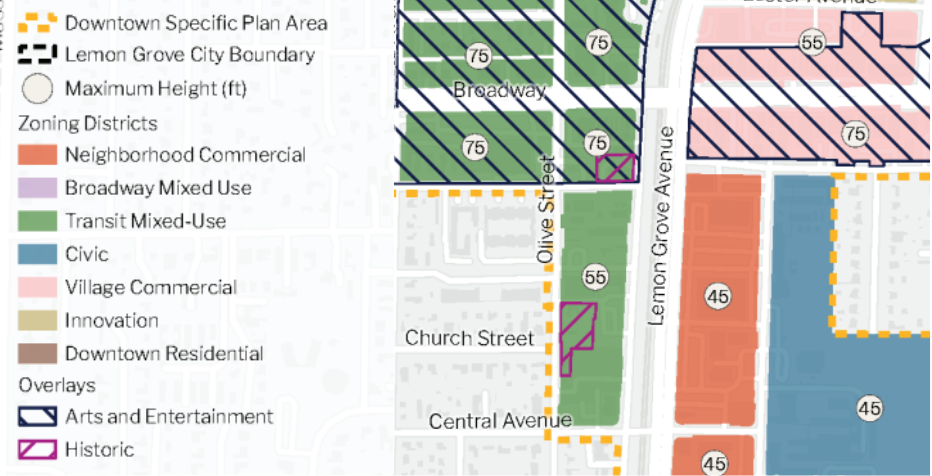 Map from Lemon Grove Downtown Plan Update, edited to display historic properties (City of Lemon Grove)
What is the Draft Lemon Grove Downtown Specific Plan?
Lemon Grove recently released their draft for the Downtown Specific Plan, which applies to a much wider area than the current Downtown Plan adopted in 2005, and includes nearly all of the Lemon Grove Depot TOD area. This plan is based on the work previously done in an attempted update in 2018 that was rejected by City Council. Building densities in this 2018 plan were between 2 and 5 stories, with much of the plan area dominated by an Innovation District which did not allow housing. The main changes from the new plan update, as presented are to align with the Lemon Grove Housing Element, Climate Action Plan, reflect changes in state law (not limited to SB 79), ensure the plan is adjusted based on parcel sizes, and more.
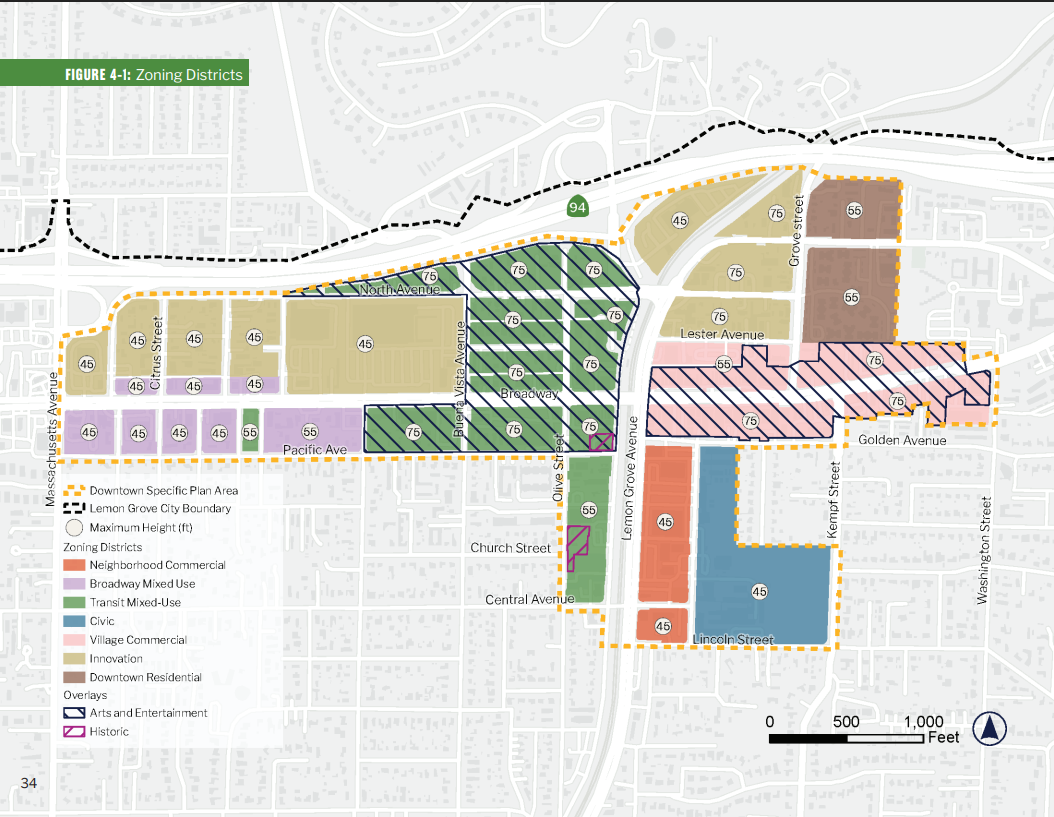 Map of the Draft Downtown Plan Update zoning (City of Lemon Grove)
A vast area was upzoned as part of their Transit Mixed-Use zoning, land uses that are currently Heavy Commercial or general commercial currently. In this zone, the goal is to build transit oriented housing with a max DU/AC of 80. This zoning change alone allows for an additional 2280 units, with height limits of 75 feet in most of the zone.
The next major upzone is to the existing Village Commercial zones, this is much of their main street and represents the core of Downtown Lemon Grove. This area still requires commercial use but also now allows for 60 DU/AC, adding much needed residential to their core.
There is also Neighborhood Commercial zoning with expanded retail uses, Broadway Mixed Use Zoning, a lower intensity zoning along Broadway corridor, east of the station area TOD zoning. And Downtown Residential Zoning, allowing dense residential uses at 40 DU/AC. All these land uses come together to create a cohesive, dense, destination rich downtown plan.
The location and relative scale of development, the Innovation District and borders of the plan area, many of the proposed streetscape improvements, an expanded park, a completely redesigned main street, and other road improvements remain virtually unchanged from 2018. These decisions were kept essentially the same as many of the environmental studies were able to be updated and reused from the 2018 plan study. This saved time, money, and kept the plan from containing any surprises that were not in the 2018 plan.
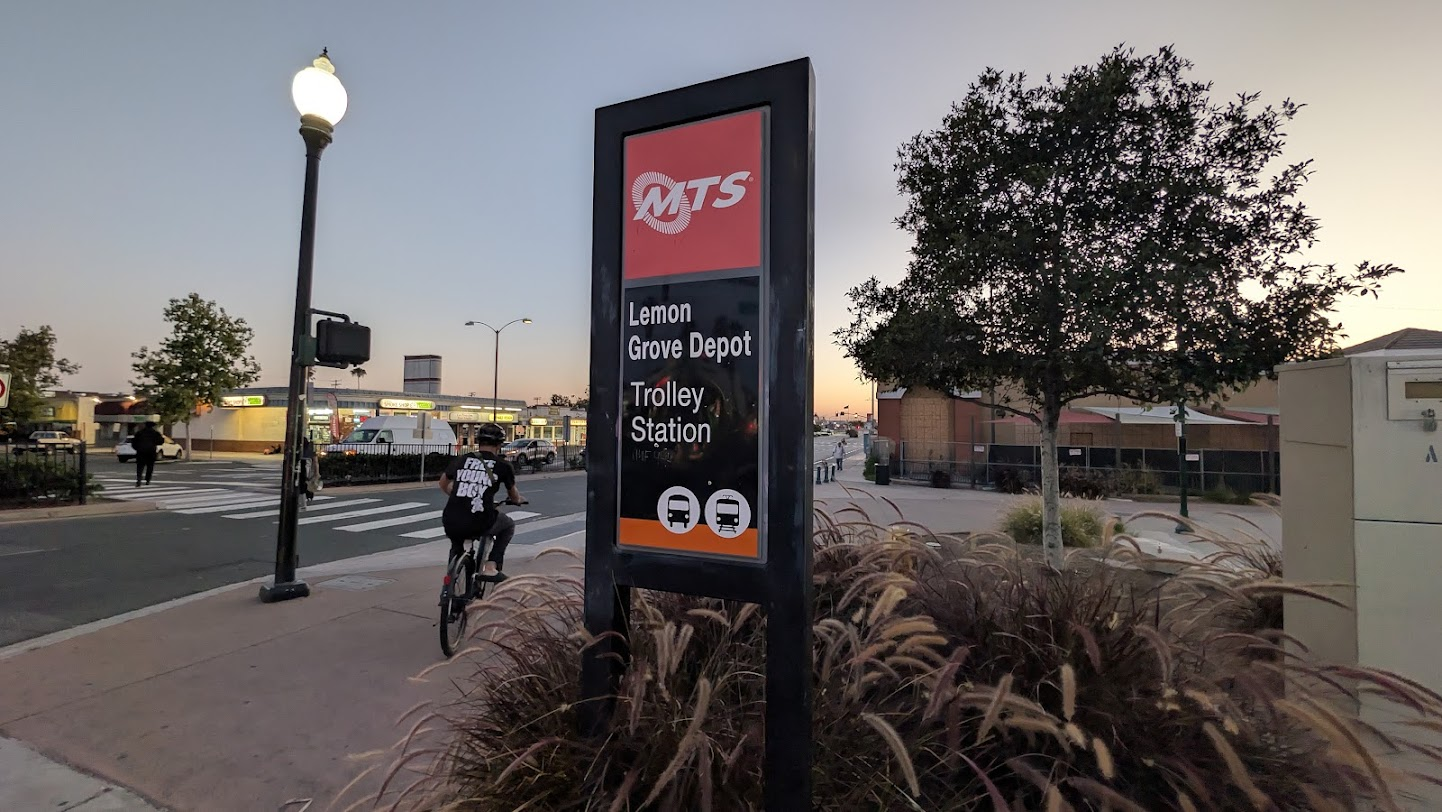 Photo by Samuel Sharp / BuildSD
Some major changes that were made were shifting from a maximum story system to maximum height, allowing for more flexibility with building design, massing, and more. There were also changes for allowed uses by right in certain land uses.
These changes will likely reflect higher density zoning on larger parcels, and lower density on smaller parcels. But to align with the Lemon Grove Housing Element to build 1359 housing units by the middle of 2029. Additionally Lemon Grove has only built 358 housing units since 2021, only 26% of their Regional Housing Needs Assessment (RHNA) requirement.
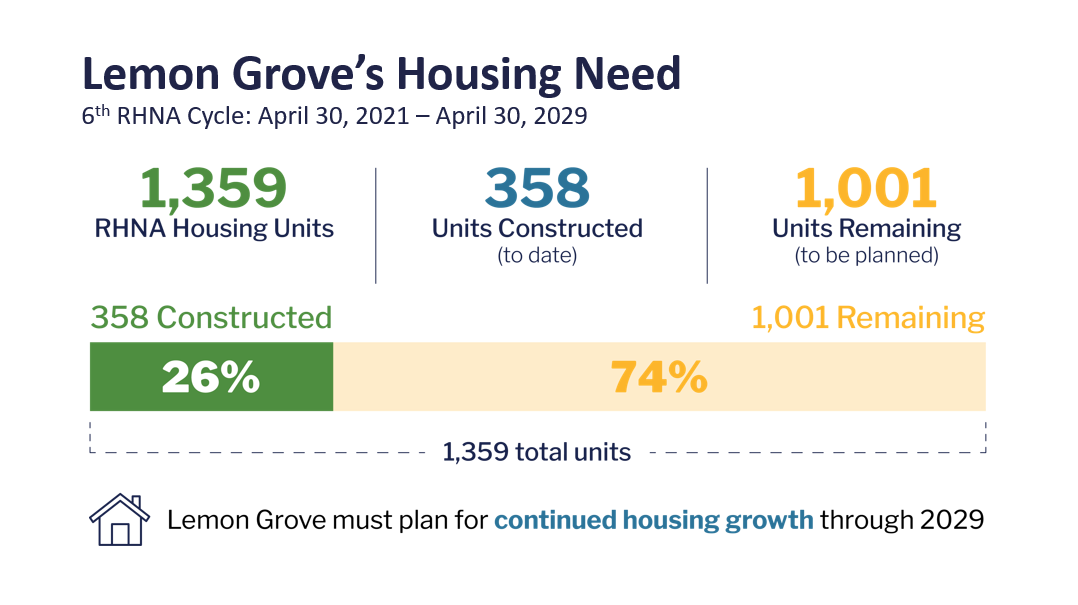 Graphic courtesy of the City of Lemon Grove
It is now 2026 and a promised rezoning of the Massachusetts Avenue Station, particularly the adjacent U-Haul site, is still yet to occur, as the Downtown Plan Update is finally being passed. As developments take years to permit and construct, this will likely carry through to 2029 and it is highly unlikely Lemon Grove will meet their RHNA requirements. If these are not met, there are real consequences. This means in 2031 Lemon Grove would need to do further upzoning, would be required to add on any unbuilt units to their next RHNA cycle, and the state’s Builders Remedy law would apply more severely. Lemon Grove is already subject to Builders Remedy, but so far there have been no takers.
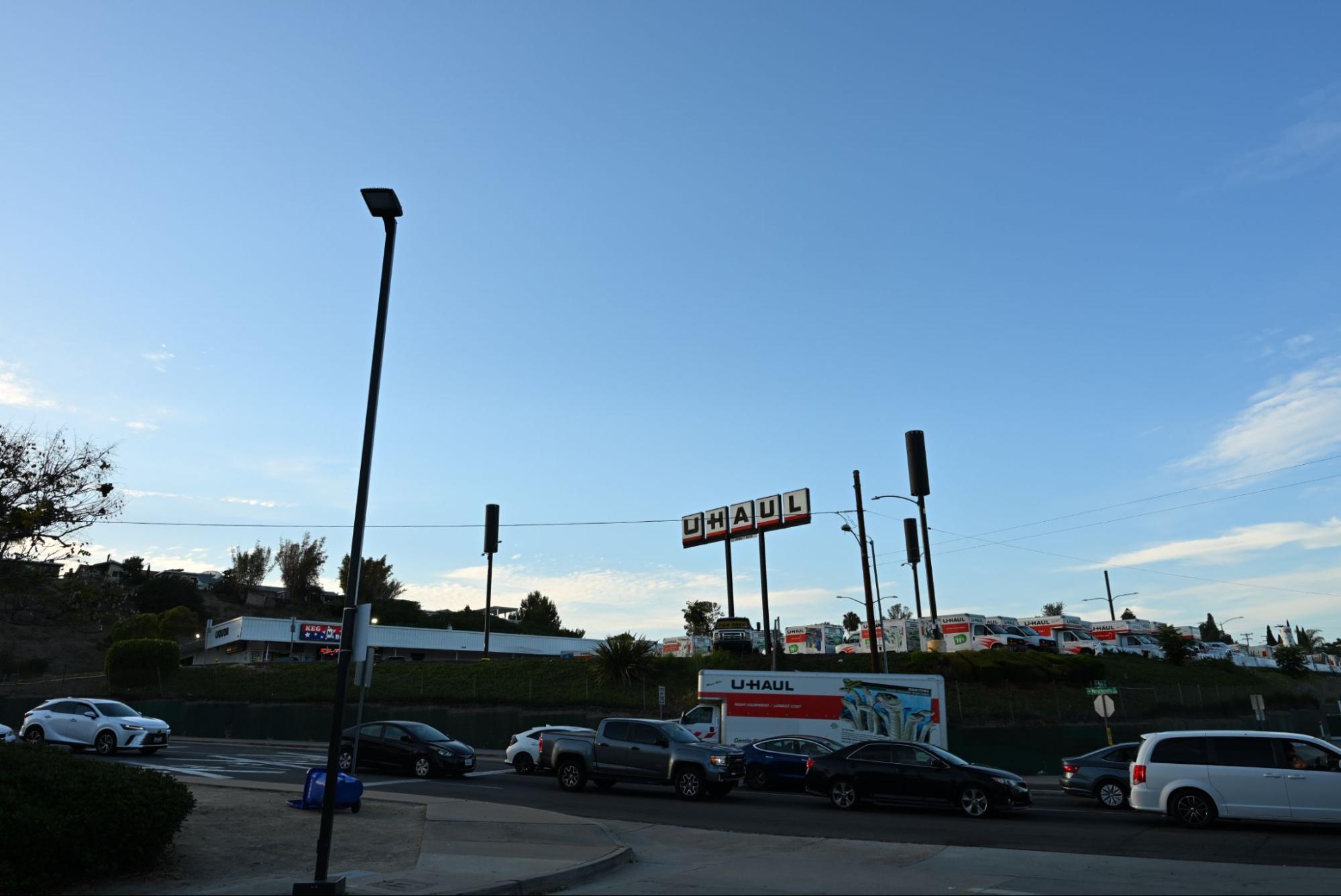 Photo by Maxwell G. / BuildSD
Innovation District
If the Downtown Plan Update were to affect the city’s decision-making for the TOD Alternative Plan, it would likely be through the Innovation District. However, new industrial zoning in this district could be potentially used to block SB 79. During the July 7th City Council meeting, a councilmember asked for zoning to be changed from commercial to light industrial as part of the downtown plan to exempt the land from SB 79. This brings concern that the city may attempt to use this Innovation District zoning to block housing. If this is done, it would likely be illegal.
There is further reason to add the light industrial uses to the Innovation District aside from preserving existing uses. Notably, the San Diego region’s persistently booming biotech industry typically requires light industrial zoning. In the City of San Diego, R&D offices are required to be in light industrial zones, which includes defence design, biotech, and semiconductor design and testing labs, all big industries in San Diego.
Additionally, this zoning also allows for more typical office, medical uses, and light manufacturing, and educational uses.
How to Shift Density and avoid SB 79
Lemon Grove city staff has indicated the city is interested in filing a TOD Alternative Plan after their Downtown Specific Plan update is complete, stating that the changes to the downtown plan could significantly impact how they would implement a TOD Alternative Plan.
Under a TOD alternative plan, there are a few things Lemon Grove could do now, mainly shifting of density from one area to another. A parcel can have at most 50% of its density shifted to another parcel, even in another TOD zone; however, no parcel can have double its allowed zoning. If Lemon Grove wishes to shift density from Massachusetts Avenue Station to sites in their downtown, they could.
Option One: Shift Density from Massachusetts Avenue to Downtown
A full density shift could result in up to a 12 story building or 14 story building in the immediate station area zone. This likely allows for the limit of density shifting from Massachusetts Avenue Station. The Downtown Plan Update does not seriously impact this idea, and the shifting option would almost certainly preclude the second option.
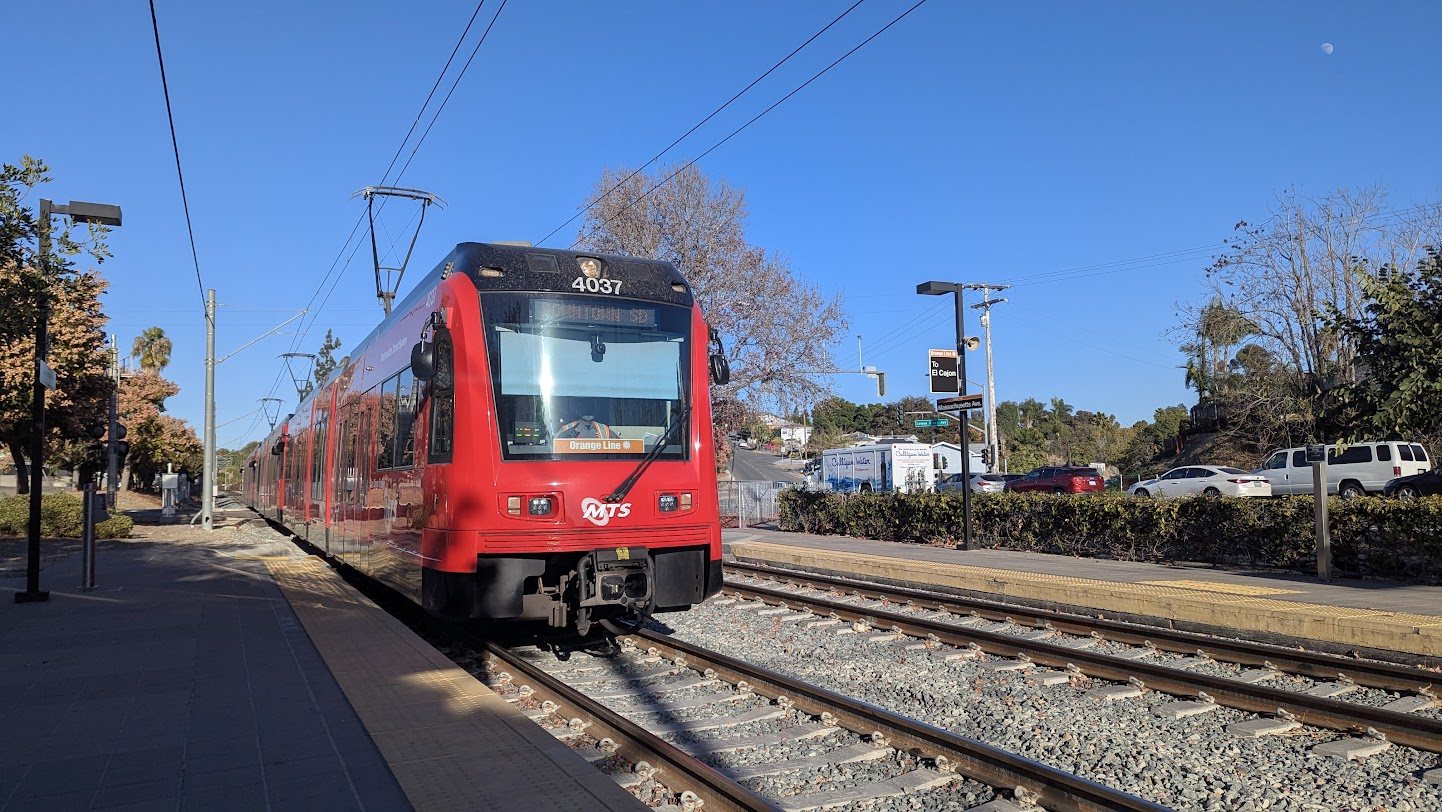 Photo by Samuel Sharp / BuildSD
Option Two: Delay density in Downtown by achieving half of what SB 79 requires, and deliberate rezonings to preclude SB 79 from certain parcels
There is also a potential variant of this option that could be used. Lemon Grove would need to think it through, but if they could achieve 50% of SB 79 zoning across their two station areas, they could delay both until 2031 due to being Low Resource Areas. This would be complicated, but it could be said they are already on track to meet this goal. By exempting about a quarter of the area near Massachusetts Avenue Station, however, they have made this significantly more difficult. A pathway to do so could be to achieve upwards of 90% of what SB 79 requires in their downtown plan update, and strategic upzonings around Massachusetts Avenue Station, specifically the station parking lot and the neighboring U-Haul site. This option is impossible right now, as they still have not met this threshold in their SB 79 areas.
Option Three: Site-Specific Delays
This is by far the most likely delay. After the downtown plan update goes through, about half of the zoned areas would be over this 50% threshold to delay. This includes within the immediate area as well. Any Transit Mixed-Use zoned areas would be eligible in both the quarter mile and immediate area, and the Village Commercial zoning would be eligible in the quarter mile area but not the immediate area. This is by far the most likely option as it would delay SB 79 on much of their main street and station area.
Option four. Lemon Grove could also use a site by site specific delay, if the upzoning they achieve on a parcel is 50% of what SB 79 would allow, they could delay the site. This is by far the most likely delay. After the downtown plan update goes through, about half of the zoned areas would be over this 50% threshold to delay. This includes within the immediate area as well. Any Transit Mixed-Use zoned areas would be eligible in both the quarter mile and immediate area, and the Village Commercial zoning would be eligible in the quarter mile area but not the immediate area. This is by far the most likely option as it would delay SB 79 on much of their main street and station area.
What could development look like in Lemon Grove with SB 79?
The biggest change is likely to be seen in their Downtown area, specifically many large commercial parcels to the northeast of the station area with prime redevelopment potential. This area is primarily located in the draft plan update’s Innovation District, which does not allow housing. However, SB 79 does apply in this area, creating the opportunity to build housing. The lots in this part of Downtown tend to be larger than average. Property owners in these areas tend to be investors who rent the property out, or owner operators who would take the influx of cash and rent or buy elsewhere if it makes sense. The City of Lemon Grove seems to agree, listing many of these parcels in the Innovation District as “High Development Potential” in their SB 79 analysis.
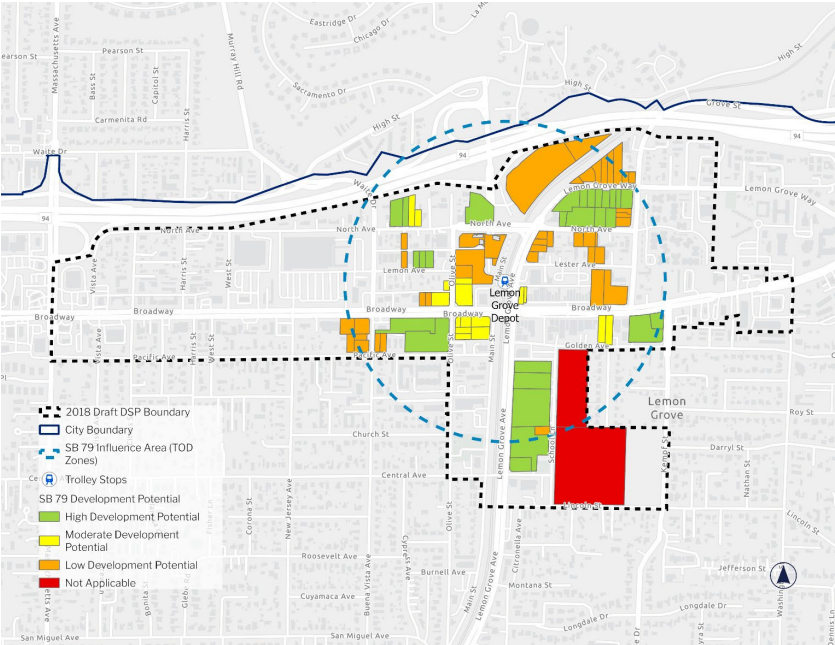 Properties that the City of Lemon Grove believes are likely candidates for redevelopment with SB 79 within their Downtown Specific Plan Update boundary (City of Lemon Grove)
Another area likely to see redevelopment in the Downtown area would be strip mall-style commercial properties such as the Home Depot on the edge of the plan area, or many properties along Lemon Grove Avenue or the west side of Broadway. Often with large parking lots and single story buildings, the potential for development is high.
The same is true around the Massachusetts Avenue station site. The station parking lot itself is currently listed on the MTS real estate page as "Available," and MTS has taken on multiple Transit Oriented Developments along the East Line corridor in recent years, including the Villa Encantada development at Encanto / 62nd Street Station, and the future Spring View Apartments at Spring Street Station. The property with the U-Haul and liquor store near the station also has a high potential for development. If development were to happen on land that is currently single-family residential, it would likely be on the largest lots.
As Lemon Grove completes their Downtown Plan Update, which will be voted upon today by the city’s Planning Commission, then by the City Council on October 6th, and potentially officially adopted upon a second reading by City Council on October 20th. It’s worth paying attention to what this small city will do in the upcoming months and years. Will Lemon Grove grow ripe and become a thriving city to the east of San Diego?
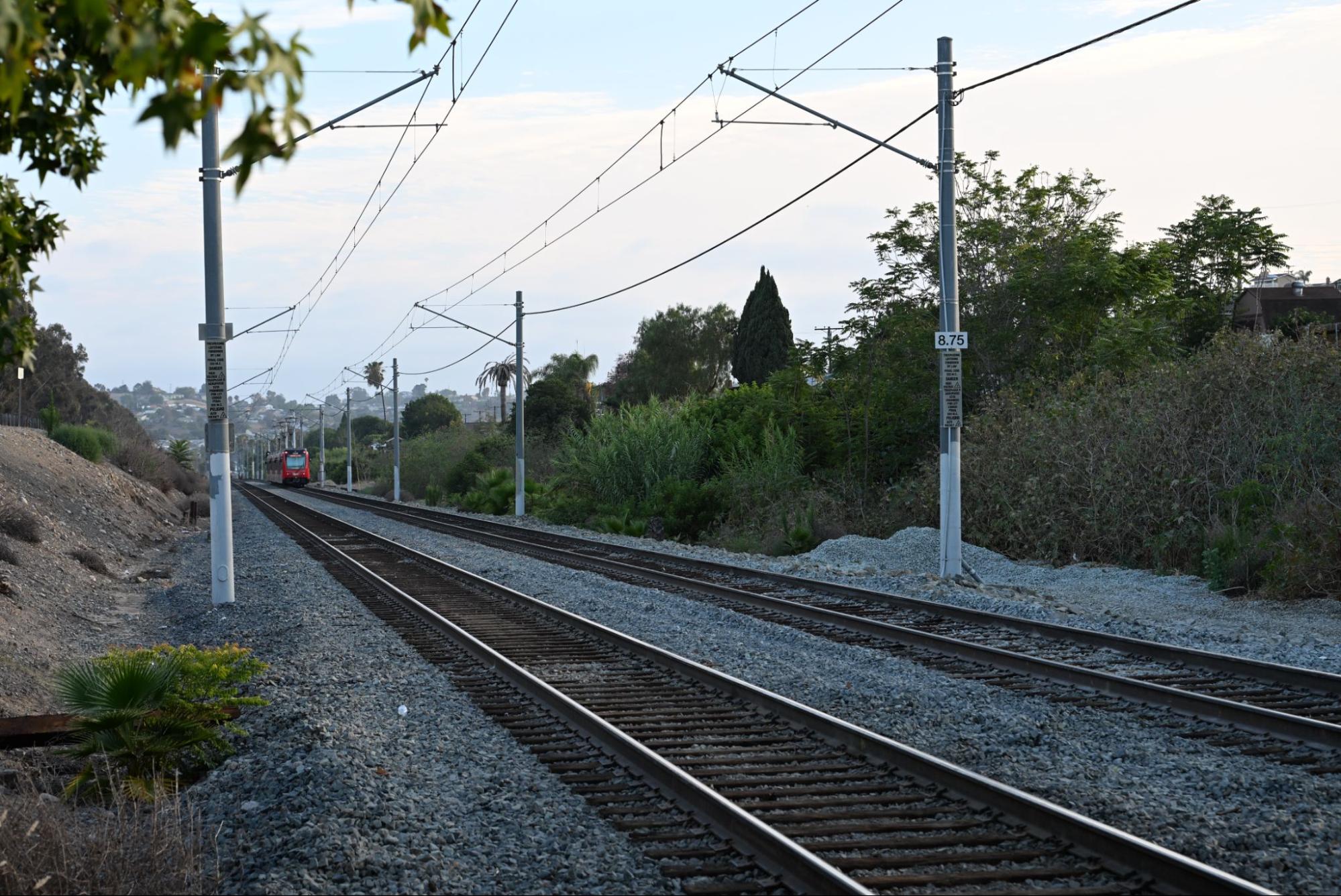 Photo by Maxwell G. / BuildSD
Further reading
https://www.lemongrove.ca.gov/media/jbka0u5c/lemon-grove-dsp_public-review-draft.pdf
https://www.lemongrove.ca.gov/media/3bydszo0/downtown-specific-plan-reduced.pdf
https://www.lemongrove.ca.gov/media/fmimo3o1/lemon-grove-workshop-1-presentation-final.pdf